

Why Subscriptions Accumulate Without You Noticing
The mechanics behind subscription creep are straightforward: companies deliberately make signing up faster and easier than canceling. A free trial requires one click; canceling often requires navigating multiple screens, confirming reasons, and sometimes even a phone call. That friction gap is by design.
Beyond the business model, there's a psychological element. Each $9.99 or $14.99 charge feels minor in isolation - far below the threshold that triggers a serious budget conversation. But a household carrying ten of those charges is spending roughly $100 to $150 per month before accounting for annual memberships, app store subscriptions, and services billed quarterly.
Subscriptions also tend to slip into the mental category of "already decided" expenses, which means people rarely re-examine them. That set-it-and-forget-it quality is part of why subscriptions are one of the spending categories that consistently catch people off guard.
$219/mo
Average U.S. household subscription spending
Consumer research from West Monroe Partners found that U.S. consumers underestimate their monthly subscription spending by nearly 100%, with actual totals frequently exceeding $200 per month.
4 in 5
Consumers who underestimate subscription costs
Multiple surveys consistently show the majority of consumers significantly underestimate how much they spend on subscriptions when asked to self-report before reviewing their statements.
$912/yr
Cost of 3 forgotten $6-$8/month services
Three small subscriptions at an average of $7.60 per month each add up to roughly $912 per year - illustrating how modest individual charges accumulate into a meaningful annual figure.
How to Audit Your Subscriptions in Under an Hour
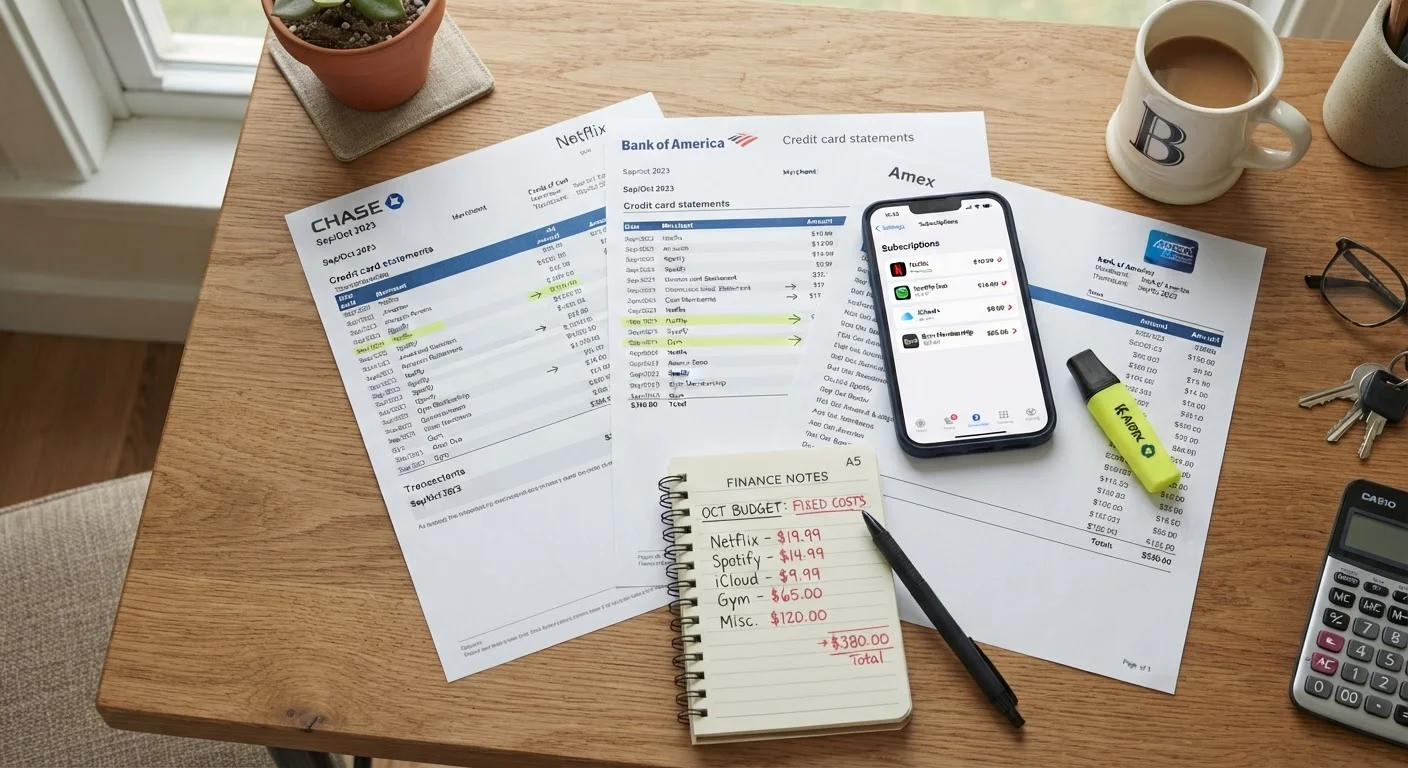
The most reliable method is a straightforward bank statement review. Pull three months of statements from every account you use for purchases - checking, savings-linked debit, and all credit cards. Look for any charge that repeats at the same amount from the same merchant. Write each one down with the amount and billing frequency.
Next, sort the list into three columns: use regularly, use occasionally, and haven't used in over a month. The third column is your immediate cancellation list. The middle column deserves honest scrutiny - occasional use rarely justifies a recurring monthly fee.
Also check your email inbox. Search terms like "your subscription," "receipt," "billing," and "renewal" often surface charges tied to email addresses or accounts you've forgotten about. Your phone's app store (both iOS and Android) maintains a list of active subscriptions under your account settings - this is easy to overlook and often contains charges from apps you deleted months ago.
Use a Dedicated Card for Free Trials
Consider using a single credit card exclusively for free trial sign-ups and recurring subscriptions. This concentrates all recurring charges in one place, making your monthly audit much faster - you only need to review one statement for subscription activity. Some banks also allow virtual card numbers, which can be paused or deleted to block unwanted renewals.
For a more structured approach, the Monthly Budget Audit Checklist can help you weave subscription reviews into a regular end-of-month routine, so creep doesn't have time to compound.
The Free Trial Trap and Other Common Entry Points
Free trials are the single most common pathway to unintended subscriptions. The trial period is genuine - but the automatic conversion to a paid plan happens regardless of whether you actually used the service. Many companies also send the trial-ending reminder to a promotions or spam folder, making it easy to miss.
Other common entry points include:
- App in-app purchases that default to recurring billing rather than one-time payment
- Annual renewals that feel distant when you sign up but arrive as a lump charge a year later
- Bundled add-ons tacked onto phone, internet, or cable bills that are easy to overlook on a detailed statement
- Household overlap - multiple family members independently subscribing to the same service
These are distinct from hidden fees that inflate everyday bills, which are charges you didn't agree to - subscriptions are ones you did agree to, just didn't remember or actively choose to keep.
Making the Cut: Deciding What to Keep
The decision isn't always obvious. A useful mental test: if this subscription disappeared tomorrow, would you notice within a week? If the answer is no, that's a strong signal it isn't delivering enough value to justify the ongoing cost.
For services you genuinely use but want to spend less on, consider switching from monthly to annual billing (which typically saves 15-20%), or downgrading to a lower tier. Sharing family or group plans for services that allow it is another way to preserve access while reducing what each person pays.
Be honest about "aspirational" subscriptions - fitness apps, language learning platforms, or creative tools you signed up for with good intentions but rarely open. These are worth canceling and potentially re-subscribing if you find yourself missing them. Re-subscribing is always an option; the money spent while the subscription sits unused is not recoverable.
Subscription creep doesn't happen from a single bad decision - it accumulates the same way small shopping habits quietly erode a budget: gradually, without any single moment that feels like a mistake. That's what makes a periodic audit so valuable.
“The most dangerous financial habits are the ones that feel painless in the moment. Subscriptions are engineered to feel like a non-decision - and that's exactly why they deserve active scrutiny.”
— Finance Editorial Team, Consumer finance writers and editors
This article is for general informational purposes only and does not constitute personalized financial advice. Consider consulting a qualified financial professional for guidance specific to your situation.
Frequently Asked Questions
Subscription creep is the slow accumulation of recurring charges that builds up over months or years. It happens because signing up is frictionless, charges are automatic, and no single cost feels large enough to prompt action. Over time, the total becomes significant without any single moment that feels like overspending.
Review three to six months of bank and credit card statements and flag any recurring charge. Check your email inbox for subscription confirmation emails, and look through your phone's app store account page, which usually lists active in-app subscriptions. Some banking apps also have built-in tools that categorize and surface recurring transactions.
Estimates vary, but surveys consistently suggest many households spend well over $200 per month on subscriptions - often more than they self-report when asked. The gap between perceived and actual spending is a consistent finding across consumer research.
Yes, if you're not actively using the service. A $6 monthly charge equals $72 per year - and five of those adds up to $360 annually. Unused subscriptions provide zero value while reducing money available for things you actually need or enjoy.
Use a dedicated card or virtual card number for free trials so you can easily spot or block new charges. Set a calendar reminder when starting any trial so you can evaluate before it converts to paid. A quick monthly statement scan also catches new charges early before they become habitual.
The content on this site is for informational purposes only and is not a substitute for professional advice. Always consult a qualified professional for guidance specific to your situation.