

Our Verdict
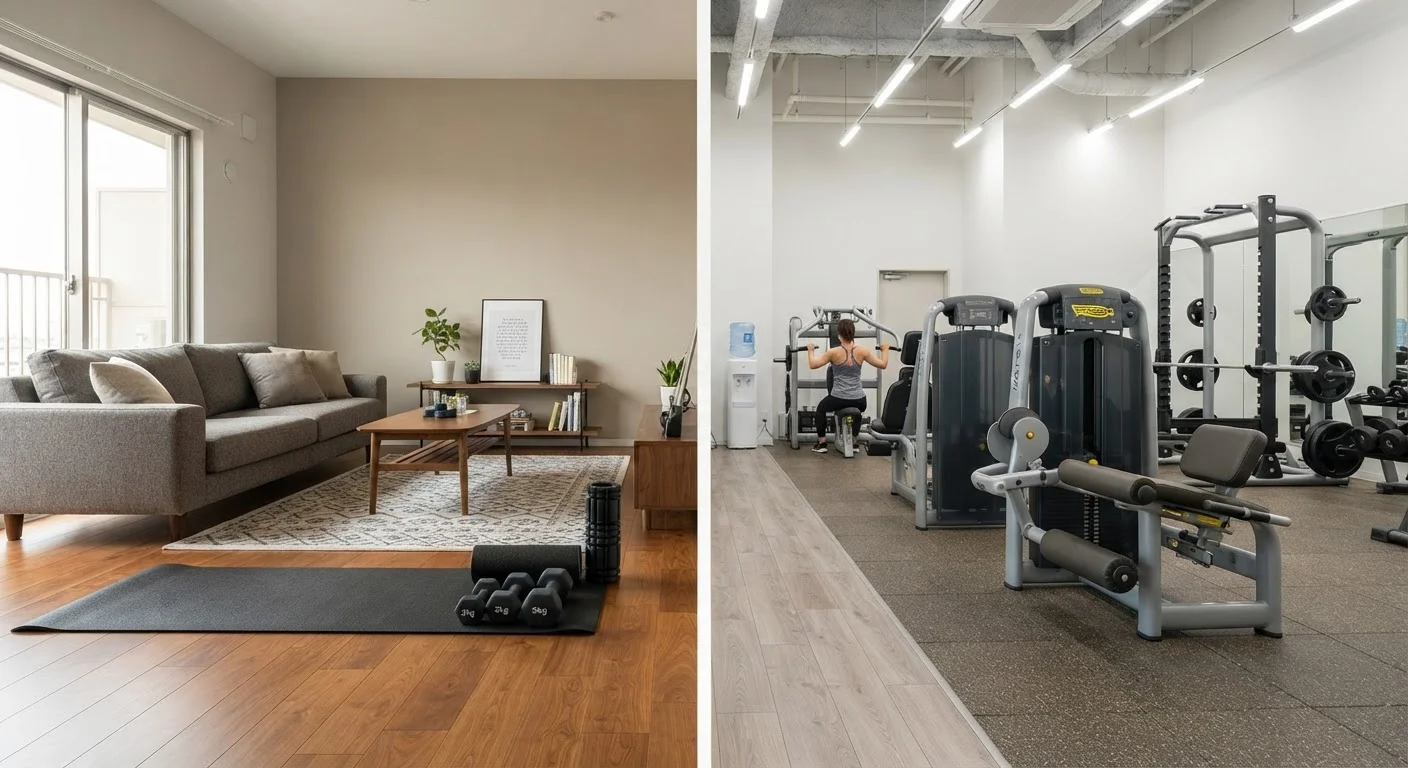
Home workouts and gym memberships both support meaningful fitness progress - what differs is the environment, resources, and structure each provides. Home training excels for convenience and cost control, while gyms offer equipment depth, community, and professional support that some goals genuinely require. Neither is a universal winner.
Home workouts suit people with tight schedules, limited budgets, or a preference for privacy; gym memberships tend to serve those who benefit from external motivation, specialized equipment, or guided instruction.
Why the Environment You Train In Actually Matters
Where you exercise shapes more than your commute - it influences what movements you can perform, how consistently you show up, and how motivated you feel. Research on exercise adherence consistently points to convenience and enjoyment as two of the strongest predictors of long-term consistency, according to the American College of Sports Medicine. That makes the home-vs.-gym question genuinely worth thinking through rather than defaulting to whichever option feels most familiar.
This isn't a debate with a clear winner. It's a practical trade-off analysis, and the right answer varies by person. Understanding what each environment actually offers - and what it doesn't - puts you in a better position to choose, or to combine both. For a deeper look at how different training styles produce different results, see this comparison of cardio and strength training.
The Real Advantages of Training at Home
Home workouts have grown significantly in popularity, and the reasons are practical rather than trendy.
No commute means fewer barriers to starting
Eliminating travel to and from a facility removes one of the most common reasons people skip sessions. Convenience is consistently linked to higher exercise frequency in behavioral research.
Lower ongoing cost after initial equipment investment
Once basic equipment is in place - a mat, resistance bands, or a set of adjustable dumbbells - there are no monthly fees. Over several years, this can represent meaningful savings compared to recurring membership costs.
Complete schedule flexibility
Home workouts can happen at 6 a.m., during a lunch break, or late at night without depending on facility hours, class schedules, or equipment availability.
Privacy and reduced social anxiety
For people who feel self-conscious in public fitness spaces, home training removes that barrier entirely and can make it easier to focus on the workout itself.
Customizable environment
You control the temperature, music, and layout - small factors that research suggests can meaningfully influence workout enjoyment and perceived exertion.
Removing the commute alone can reclaim 30-60 minutes per session for many people - time that often determines whether a workout happens at all. If you're juggling a full schedule, see how others structure their training in this guide to strength training on a busy schedule.
The Genuine Drawbacks of Working Out at Home
Home training has real limitations that are worth acknowledging honestly rather than dismissing.
Limited equipment restricts certain training goals
Progressive overload - gradually increasing resistance over time - is fundamental to strength development. Without access to heavier weights or specialized machines, some goals become harder to reach at home.
Lack of structure can undermine consistency
Without scheduled classes or a set facility routine, home workouts require more self-direction. Research on behavior change consistently shows that environmental cues and social accountability support long-term habit formation.
Home distractions compete for attention
Children, household chores, notifications, and other domestic interruptions can fragment workout quality in ways that rarely occur in a dedicated gym space.
No access to professional guidance on-site
Personal trainers, fitness instructors, and knowledgeable staff are typically gym-based. Without that resource, form errors can go uncorrected for extended periods, which may increase injury risk over time.
Upfront equipment costs can be significant
Building a functional home gym - even a modest one - involves real upfront spending. Quality adjustable dumbbells, a pull-up bar, and a bench can collectively run several hundred dollars before any training begins.
Hybrid Setups Are More Common Than You'd Think
Many people combine a minimal home setup - resistance bands, a mat, and bodyweight exercises - with occasional gym visits for heavier lifting or group classes. This approach captures much of the convenience advantage while preserving access to specialized equipment. It also provides a fallback when schedules tighten, reducing the all-or-nothing dynamic that often derails fitness routines.
If you're unsure whether your current routine is built on accurate assumptions, this look at common fitness myths addresses several widely held beliefs that the evidence doesn't support.
What the Numbers Say About Gym Use and Home Exercise
Context from population-level data helps frame the individual decision.
~64 million
U.S. gym memberships held annually
According to the International Health, Racquet & Sportsclub Association (IHRSA), tens of millions of Americans hold gym memberships, though regular attendance rates are considerably lower than enrollment figures.
~50%
New exercisers who quit within 6 months
The American College of Sports Medicine has noted that roughly half of people who start a new exercise program discontinue within six months, regardless of training location.
23%
U.S. adults meeting both aerobic and muscle-strengthening guidelines
CDC National Health Interview Survey data indicate that fewer than one in four American adults meets federal guidelines for both aerobic activity and muscle-strengthening exercise.
These figures reflect broad trends rather than prescriptions. Individual results depend heavily on adherence, program design, and overall lifestyle - not the setting itself.
Making the Decision That Actually Fits Your Life
A few honest questions can clarify the decision faster than any general recommendation:
- What's your primary barrier to working out? If it's time, home training removes friction. If it's motivation or accountability, a gym environment or class structure may help more.
- What are your specific fitness goals? Bodyweight training and light resistance work transfer well to home settings. Heavy compound lifting, swimming, or certain sports conditioning may genuinely require gym access.
- What's your realistic budget? Home equipment has upfront costs; gym memberships are recurring. Mapping out 12-month totals for each option gives a clearer comparison.
- Do you have adequate space and privacy at home? A 300-square-foot apartment creates different constraints than a basement or garage.
Many people find that a hybrid approach - maintaining a basic home setup for daily movement and using a gym periodically for heavier sessions or classes - offers the flexibility of both without the full cost of either. Whatever you choose, consistency over time matters far more than the setting. The workout you realistically complete, week after week, will always outperform the theoretically optimal routine you can't sustain.
This article is for general informational purposes only and is not a substitute for personalized advice from a qualified fitness or healthcare professional. Consult a professional before starting a new exercise program, especially if you have existing health conditions.
The content on this site is for informational purposes only and is not a substitute for professional advice. Always consult a qualified professional for guidance specific to your situation.