

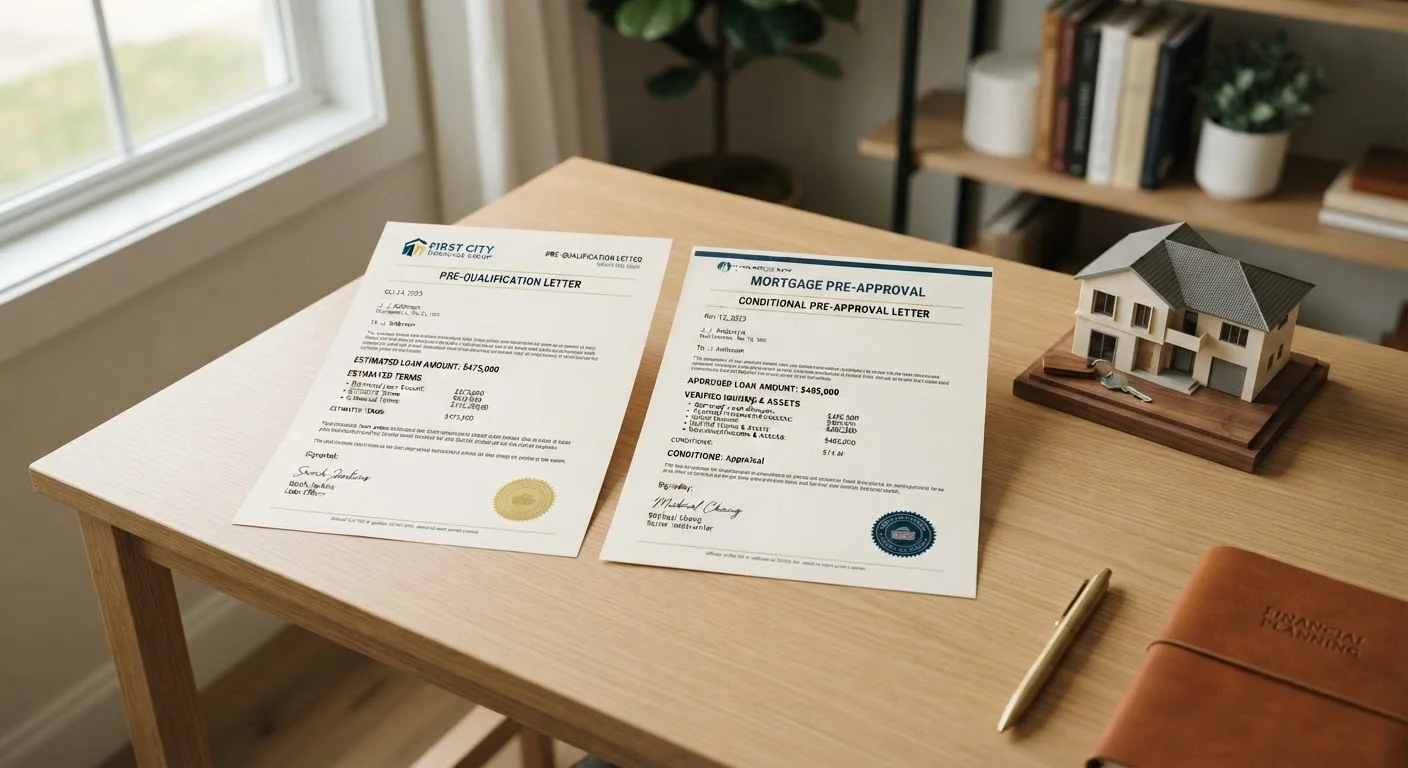
Option A
Pre-Qualification
A quick, informal estimate of what you might be able to borrow.
Best for: Buyers in the early research phase who want a rough sense of their budget before getting serious.
Option B
Pre-Approval
A verified, lender-backed statement of your actual borrowing capacity.
Best for: Buyers ready to make offers, especially in competitive markets where sellers expect documented buying power.
What Each Letter Actually Means
Both pre-qualification and pre-approval are issued by mortgage lenders and both include an estimated loan amount. On the surface, they can look nearly identical. The critical difference lies in how each one is produced - and how much a seller or real estate agent can actually trust it.
Pre-qualification is essentially a lender's educated guess. You provide basic financial details - income, monthly debts, and estimated assets - usually through a phone call or online form. The lender does no verification and, in most cases, does not pull your credit report. Based on what you tell them, they issue a letter estimating how much you may qualify to borrow. Because none of it is checked, the letter is informal by nature.
Pre-approval is a more rigorous process. The lender collects documentation - pay stubs, W-2s, bank statements, tax returns - and runs a hard credit inquiry to verify your financial profile. An underwriter reviews the file and issues a conditional commitment to lend up to a specified amount. That conditionality matters: the loan still depends on a satisfactory appraisal and final underwriting, but your financial standing has been independently confirmed.
| Criterion | Pre-Qualification | Pre-Approval |
|---|---|---|
| Information required | Self-reported income and debts | Verified documents (pay stubs, tax returns, bank statements) |
| Credit check | None or soft inquiry | Hard inquiry required |
| Lender verification | No verification performed | Underwriter reviews your file |
| Time to obtain | Minutes to a few hours | Several days to about a week |
| Seller confidence | Low - unverified estimate | High - lender-backed commitment |
| Expiration | Varies; often informal | Typically 60-90 days |
| Best used | Early budgeting and research | Active offer-making stage |
Why Sellers and Agents Care About the Distinction
From a seller's perspective, a pre-qualification letter provides very little reassurance. Because it relies on unverified, self-reported numbers, it does not tell the seller whether a buyer can actually close. In a balanced or buyer-friendly market, sellers may accept an offer accompanied by pre-qualification while the buyer upgrades to full pre-approval. But in competitive conditions - where multiple offers arrive quickly - sellers and their listing agents routinely require pre-approval before they'll engage at all.
Understanding the broader market you're shopping in makes a difference here. Reading whether it's a buyer's or seller's market before you start touring homes helps you decide how urgently you need that stronger letter in hand.
60-90
Days a typical pre-approval remains valid
Most lenders issue pre-approval letters with an expiration window of 60 to 90 days, after which documentation must be refreshed.
~5 pts
Typical temporary credit score drop from a hard inquiry
According to FICO, a single hard inquiry generally lowers a score by fewer than five points for most consumers, and the effect fades within months.
It's also worth noting that pre-approval letters carry an expiration date - typically 60 to 90 days, depending on the lender. If your home search runs longer than that, you may need to refresh the application, which means providing updated documentation and potentially another hard credit inquiry.
The Credit Check Question
One reason buyers sometimes hesitate to pursue pre-approval is concern about the impact on their credit score. That concern is understandable, but the actual effect is often smaller than people expect - and worth understanding clearly.
Pre-qualification typically involves either no credit pull at all, or a soft inquiry, which does not affect your score. Pre-approval requires a hard inquiry, which can temporarily lower your score by a few points. However, credit scoring models treat multiple mortgage inquiries made within a short window - generally 14 to 45 days, depending on the scoring model - as a single inquiry. This means you can shop multiple lenders for pre-approval without compounding the credit impact. For a fuller explanation of how these two types of checks differ, see how hard and soft inquiries work.
Rate Shopping Won't Stack Up Against Your Score
If you apply for pre-approval with several lenders to compare rates, most credit scoring models count all mortgage-related hard inquiries made within a 14- to 45-day window as a single inquiry. This is designed specifically to encourage consumers to shop around. Checking your own credit before you start - which counts as a soft inquiry - is a smart first step and has no impact on your score at all.
When to Get Each - and What Comes Next
A practical approach for most buyers: start with pre-qualification during the budgeting and research stage, then move to pre-approval before you begin serious home tours or make any offers. Pre-qualification helps you calibrate your price range and identify any obvious gaps (like a high debt-to-income ratio) before you invest time in the full documentation process.
Once you're pre-approved, remember that this is still not a final loan commitment. Full underwriting - the lender's complete review - happens after you sign a purchase agreement and a home appraisal is completed. Your financial picture must also remain stable between pre-approval and closing. Opening new credit accounts, changing jobs, or making large purchases during this period can complicate or delay the process.
When you're ready to think about which loan program makes sense for your situation, comparing FHA, VA, USDA, and conventional loan options is a useful next step. Different programs have different requirements, and the lender you choose for pre-approval can walk you through which ones you're likely to qualify for.
This article is for general informational and educational purposes only and does not constitute financial, mortgage, or legal advice. Loan eligibility, terms, and processes vary by lender and individual circumstance. Consult a licensed mortgage professional for guidance specific to your situation.
The content on this site is for informational purposes only and is not a substitute for professional advice. Always consult a qualified professional for guidance specific to your situation.