

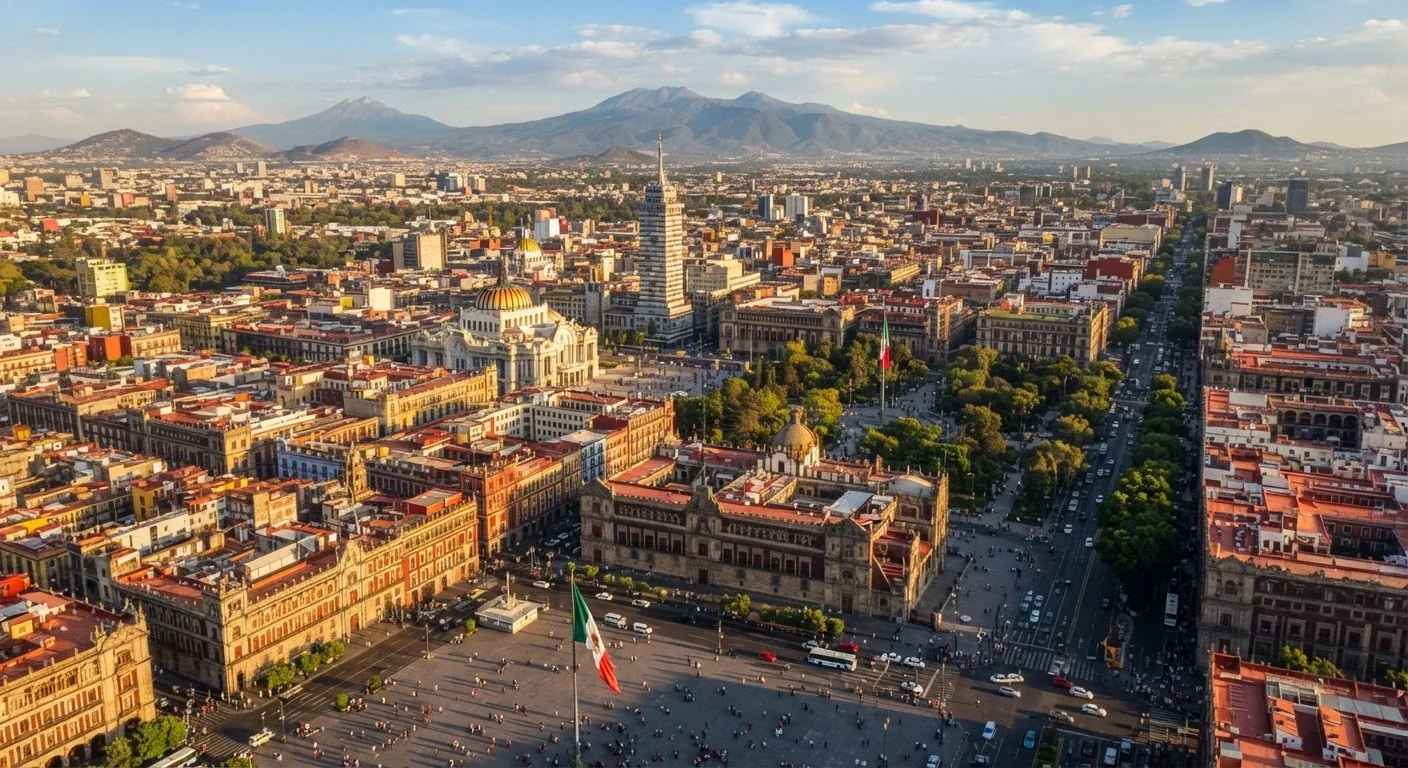
Why Mexico City Belongs on Your Radar
Mexico City - locally known as CDMX - is a place that quietly overwhelms in the best possible way. Spread across a high-altitude valley and home to over 20 million people in its greater metro area, it is one of the largest cities on the planet. Yet for American travelers, it punches remarkably close: nonstop flights from dozens of U.S. hubs make it reachable in two to five hours.
What makes CDMX distinctive is its layering. Pre-Columbian ruins sit beneath colonial-era cathedrals. World-class contemporary art museums share streets with mercados (open-air markets) that have operated for generations. The culinary scene - from humble street tacos to globe-spanning fine dining - has drawn serious attention from food journalists worldwide. If you enjoy cities that reward wandering, this one has almost no ceiling.
20M+
Greater metro area population
Mexico City's metro region is among the five largest urban areas in the world by population.
7,350 ft
Elevation above sea level
Mexico City's high-altitude location is a key practical factor for travelers arriving from sea-level cities.
UNESCO
Mexican cuisine heritage status
UNESCO recognized traditional Mexican cuisine as an Intangible Cultural Heritage of Humanity in 2010.
Neighborhoods Worth Knowing
Mexico City's colonias (neighborhoods) are distinct enough that choosing wisely can feel like choosing different cities entirely.
Centro Histórico
The historic core is where the city's story begins. The vast Zócalo plaza anchors everything - it is one of the largest public squares in the world - and nearby you'll find the National Palace, the Metropolitan Cathedral, and the Templo Mayor ruins. It's lively and bustling, ideal for soaking up history.
Condesa and Roma
These adjacent, tree-shaded neighborhoods are magnets for first-time visitors. Art Deco apartment buildings, independent coffee shops, leafy parks, and a relaxed pace make them exceptionally walkable. They're also well-stocked with restaurants catering to a range of budgets.
Coyoacán
A bohemian enclave in the south, Coyoacán has a small-town feel despite being inside the city. It's home to the Frida Kahlo Museum (locally called La Casa Azul, or the Blue House) and a colorful weekend market. The neighborhood is beloved by locals and rarely feels rushed.
Polanco
Polanco is CDMX's upscale commercial district, home to high-end hotels, embassies, and the world-class Museo Nacional de Antropología. Worth a visit for the museum alone - its collection documenting pre-Hispanic civilizations is genuinely unmatched.
Visit the Museo Nacional de Antropología early on a weekday - crowds thin significantly before 11 a.m., and the collection is large enough to warrant a full, unhurried morning.
The museum is consistently ranked among the most important anthropology museums in the world; rushing through it means missing the depth that makes it remarkable.
Load a transit app that covers the CDMX Metro before you land - offline maps save real stress when navigating a system with 195+ stations.
Cellular data can be inconsistent underground, and having a map cached locally makes the metro dramatically less intimidating for first-time visitors.
Culture, Food, and Day-to-Day Life
Culture in Mexico City is not something you seek out in dedicated hours - it surrounds you. Street murals inspired by the great Mexican muralists, impromptu music performances in plazas, and neighborhood festivals (fiestas) that pop up with joyful regularity are part of the texture of daily life.
Food deserves its own conversation. Mexican cuisine was recognized by UNESCO as an Intangible Cultural Heritage of Humanity, and in the capital you encounter its full breadth. Tacos de canasta (basket tacos) are served from bicycle carts at breakfast. Tlayudas, enchiladas, and tamales each carry regional variations you may not have encountered before. Eating adventurously here is low-risk and high-reward - street food has a strong culture of quality and repetition (vendors who cook one thing, cook it well, and cook it every day).
“Mexican food is not just about ingredients - it is about memory, community, and the daily act of sharing. Every dish carries a geography and a history.”
— Diana Kennedy, Cookbook author and authority on Mexican regional cuisine
Coffee culture has grown substantially in recent years, with independent roasters in Roma and Condesa operating at a level recognizable to any specialty-coffee fan in the U.S. Markets like La Ciudadela and Mercado de Jamaica offer crafts, flowers, and local products that make meaningful souvenirs.
Practical Realities: Getting Around and Staying Safe
The Mexico City Metro (Sistema de Transporte Colectivo) covers the city extensively and is among the most affordable urban transit systems in the Americas. For many central destinations, it is genuinely the fastest option. Ride-share apps also operate widely and provide a convenient fallback, particularly after dark or when navigating unfamiliar areas.
Check Official Advisories Before You Go
The U.S. State Department issues travel advisories for all Mexican states, and conditions can vary significantly by area. Review the current advisory at travel.state.gov and sign up for Smart Traveler Enrollment Program (STEP) alerts before departure. This gives you access to updated safety information and makes it easier for the U.S. embassy to assist you if needed.
Safety considerations deserve honest acknowledgment. Like any large city, Mexico City has neighborhoods with higher crime rates than others. The colonias popular with visitors - Roma, Condesa, Polanco, Coyoacán, Centro - are generally well-trafficked and considered lower-risk, but no destination is without concern. Standard urban caution applies: stay aware of surroundings, avoid displaying expensive gear, and use app-based transport rather than unmarked taxis. The U.S. State Department maintains current travel advisories at travel.state.gov - consulting that resource before and during your trip is always worthwhile.
Altitude is a genuine factor. At roughly 7,350 feet above sea level, Mexico City sits higher than Denver. Visitors arriving from lower elevations sometimes experience mild altitude sickness - headache, fatigue, or shortness of breath - in the first day or two. Hydrating well, avoiding heavy meals immediately after arrival, and building in a slower first day goes a long way.
Planning Your Visit
Mexico City works well as a standalone destination or as an anchor in a broader itinerary. If you're considering pairing it with other Mexican cities like Oaxaca, Puebla, or San Miguel de Allende, the approaches for managing multi-city trips can help you sequence logistics without burning yourself out.
Most Americans do not need a visa to enter Mexico for tourism, but entry requirements can change - confirm current rules with the Mexican consulate or U.S. State Department before traveling. Travel insurance that includes medical coverage is worth serious consideration, especially given the altitude variable and the cost of international medical care.
The dry season (roughly November through April) is generally the most comfortable for visiting, with lower humidity and fewer afternoon rain showers. That said, CDMX's climate is mild year-round by virtue of its elevation - it rarely gets very hot or very cold.
Five days is a reasonable minimum to move through two or three neighborhoods, visit the major museums, and still eat well without feeling rushed. Many visitors find themselves wishing they had planned for more.
This article provides general travel information only. Entry requirements, safety conditions, and local regulations can change - always verify current details with official government sources (including the U.S. State Department and Mexican consular authorities) before making travel decisions.
The content on this site is for informational purposes only and is not a substitute for professional advice. Always consult a qualified professional for guidance specific to your situation.