

Our Verdict
State minimums satisfy the law but routinely fall short of real-world accident costs. For most drivers - especially those with savings, a financed vehicle, or dependents - carrying only the minimum is a financial risk, not just a coverage gap. Understanding what each coverage type actually does is the first step toward choosing limits that reflect your actual exposure.
| Best for | Recommended |
|---|---|
| Drivers with an older paid-off vehicle and limited assets | State minimum (with careful evaluation) |
| Drivers with financed or leased vehicles | Higher liability plus comprehensive and collision coverage |
| Drivers with significant savings or assets to protect | Higher liability limits, potentially with an umbrella policy |
| Anyone unsure about their current coverage gaps | Review with a licensed insurance agent |
What State Minimums Actually Cover
Every state (except New Hampshire, which has its own rules) requires drivers to carry at least a baseline level of auto insurance. That baseline is almost always liability coverage - meaning it pays for injuries and property damage you cause to other people in an at-fault accident.
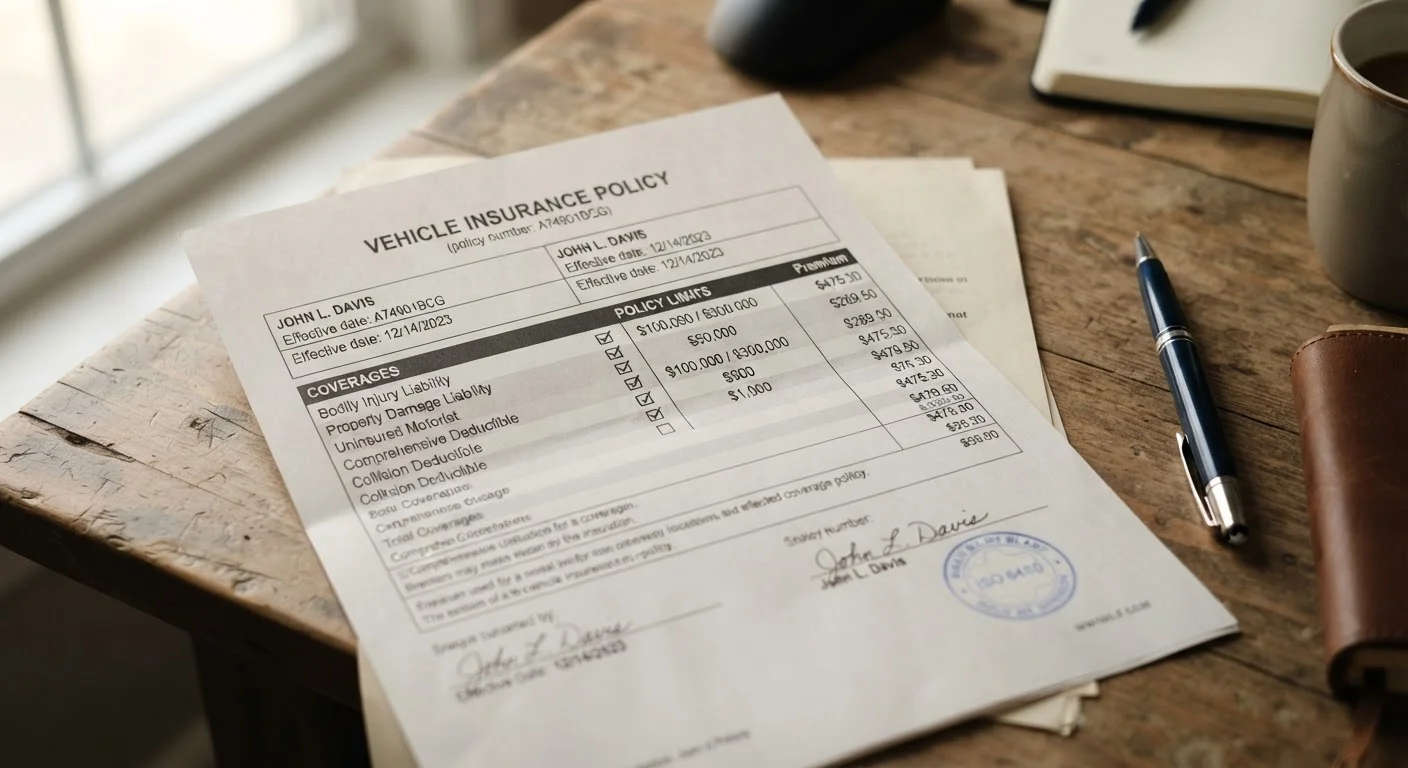
Liability limits are written as three numbers, like 25/50/25. These represent, in thousands of dollars: the maximum paid per injured person, the maximum paid per accident for all injuries combined, and the maximum paid for property damage. So a 25/50/25 policy - which several states use as their floor - tops out at $25,000 per person and $50,000 per accident for bodily injury, and $25,000 for property damage.
What state minimums generally do not include: any payment for your own injuries, damage to your own vehicle, or protection if the other driver is uninsured. For a fuller breakdown of coverage categories, see this primer on auto insurance basics.
| State Minimum Coverage | Higher-Limit / Broader Coverage | |
|---|---|---|
| Legal requirement met | Yes | Yes |
| Covers damage you cause to others | Yes, up to low limits | Yes, up to higher limits |
| Covers your own vehicle damage | No | Yes (with collision/comprehensive) |
| Covers your own medical bills | Rarely | Yes (with PIP or MedPay) |
| Protects assets if sued | Limited | Better protected |
| Required for financed/leased vehicles | No (lender requires more) | Yes |
| Monthly premium | Lower | Higher |
| Out-of-pocket risk in major accident | High | Lower |
Where the Gaps Show Up
The math on minimum limits breaks down quickly in a real accident. The average cost of a hospitalization following a motor vehicle crash routinely exceeds $50,000, according to data from the Centers for Disease Control and Prevention. A single serious injury claim can surpass a minimum policy's entire per-accident limit - leaving you personally responsible for the remainder.
Property damage limits face similar pressure. A newer vehicle can cost $35,000 or more to replace. If your policy's property damage cap is $10,000 or $15,000, you're on the hook for the difference.
Low Limits Can Expose Your Personal Finances
If damages from an at-fault accident exceed your liability limits, the injured party can sue you for the remainder. Wages, savings, and other assets may all be at risk. Carrying limits closer to your net worth is a commonly cited guideline - though a licensed agent can help you evaluate what makes sense for your situation.
There are also coverage types that minimums completely omit. Collision coverage (which pays to repair or replace your car after an accident) and comprehensive coverage (which covers theft, weather, and non-collision damage) are never part of a state minimum. If your car is financed or leased, your lender typically requires both - meaning you're already required to carry more than the state mandates. See our comparison of liability-only vs. full coverage for more on that distinction.
How to Think About the Right Amount for You
There's no universal correct answer, but there are useful questions. First: what are your assets worth? Liability coverage protects you from being sued for the difference when damages exceed your limits. If you have savings, a home, or income a court could garnish, low limits expose all of it.
Second: what is your car worth? If your vehicle is older and its market value is low, paying for collision and comprehensive may cost more than a payout would ever cover. If it's newer or financed, skipping those coverages usually isn't an option - and often isn't wise.
Third: do you have health insurance that would cover your injuries in an accident? States that don't require personal injury protection (PIP) or medical payments coverage leave your own medical bills entirely to your health plan - or to you.
Check Whether Your State Requires PIP or Uninsured Motorist Coverage
Some states mandate personal injury protection (PIP) or uninsured motorist coverage as part of their minimum requirements - others do not. If your state doesn't require them, they're still worth considering. Roughly one in eight drivers on U.S. roads is estimated to be uninsured, according to the Insurance Research Council, meaning an accident with an at-fault uninsured driver could leave you without recourse unless you've added that protection.
Before your next renewal, it's worth reviewing your policy line by line. This checklist of questions to ask before signing can help you spot limits or exclusions you may not have noticed when you first enrolled. And as your life changes - a new car, a new home, a pay increase - your coverage needs will shift too. Keeping your policy current over time is an ongoing task, not a one-time decision.
This article is for general informational purposes only and does not constitute personalized insurance, financial, or legal advice. Coverage requirements, limits, and terms vary by state and by provider. Consult a licensed insurance agent or adviser to evaluate your specific situation.
The content on this site is for informational purposes only and is not a substitute for professional advice. Always consult a qualified professional for guidance specific to your situation.