

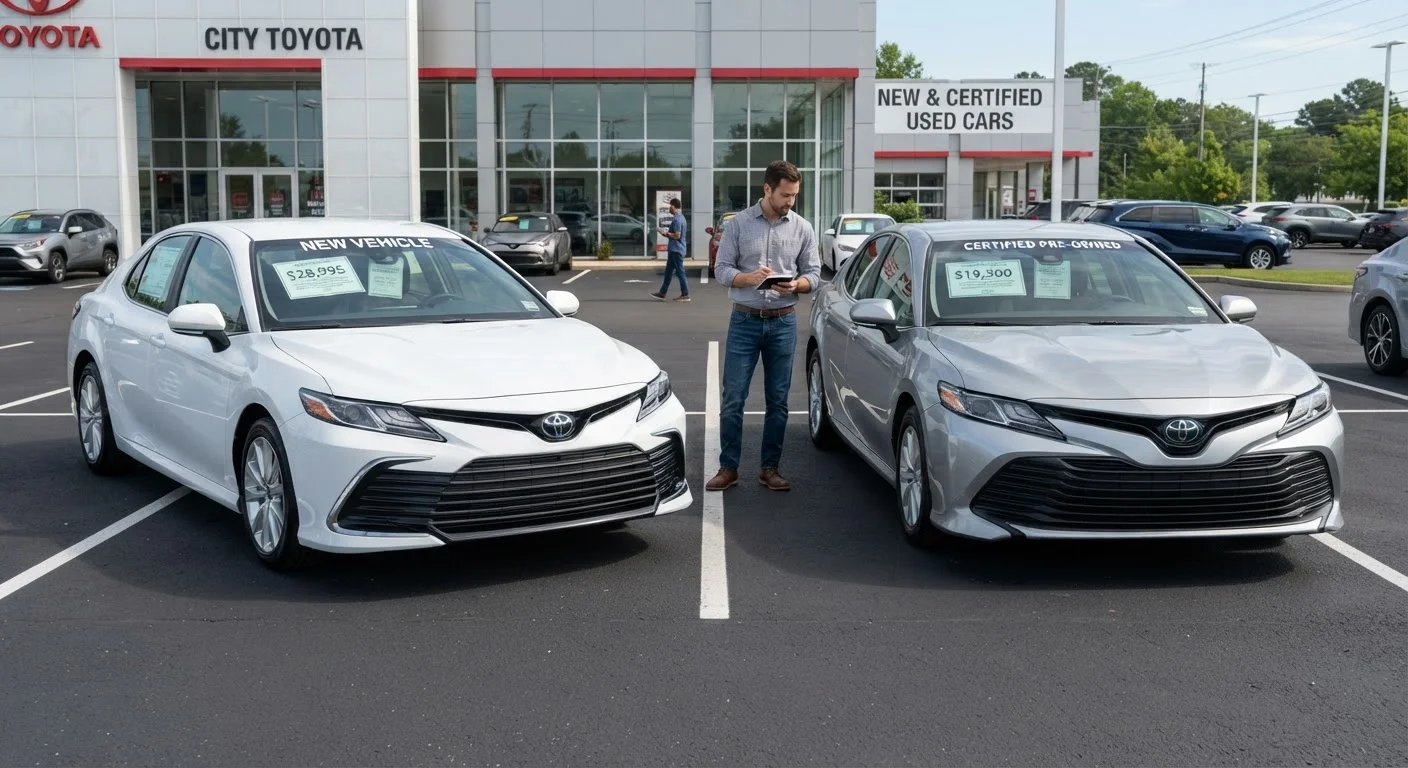
Option A
New Car
The full-warranty, zero-history option.
Best for: Buyers who want the latest safety technology, manufacturer warranty coverage, and don't mind paying a premium for peace of mind.
Option B
Used Car
The lower-cost, depreciation-avoiding alternative.
Best for: Budget-conscious buyers willing to do some homework in exchange for a significantly lower purchase price and slower value loss.
Depreciation: Where the Biggest Dollar Difference Lives
A new car loses a significant portion of its value in its first few years - commonly cited estimates suggest roughly 20% in the first year alone, with the steepest drop front-loaded into years one through three. When you buy used, you let a previous owner absorb that loss. The vehicle you're considering at two or three years old may have shed thousands in value already while still having plenty of reliable life ahead.
That math is the core argument for buying used. But it cuts both ways: if you plan to own the vehicle for a decade, the depreciation curve flattens considerably, and the new-car premium becomes easier to justify spread over a long ownership period.
~20%
Typical first-year new car depreciation
Industry estimates commonly place new vehicle value loss at roughly 20% in the first year of ownership, with continued decline through year three.
~50%
Value remaining after five years
Many vehicles retain roughly half their original value at the five-year mark, though this varies significantly by make, model, and market conditions.
1-2%+
Typical rate gap: new vs. used loans
Used-car loan rates are generally higher than new-car rates from the same lender, with the gap varying by credit score, loan term, and vehicle age.
To understand how depreciation fits into your full ownership picture, see the real costs of owning a car beyond the sticker price.
Warranty and Reliability: Known vs. Unknown History
New cars come with a manufacturer's warranty - typically three years or 36,000 miles for bumper-to-bumper coverage, and five years or 60,000 miles for the powertrain, though terms vary by manufacturer. That coverage means early repair costs largely fall on the manufacturer, not you.
Used vehicles present more uncertainty. Depending on age and mileage, the original warranty may be expired or nearly so. You're also inheriting whatever maintenance habits - good or bad - the previous owner followed. A vehicle history report and a pre-purchase inspection by an independent mechanic can surface hidden problems before you commit. Our pre-purchase checklist for used cars walks through exactly what to verify.
Certified pre-owned (CPO) vehicles occupy a middle ground: they've passed a manufacturer-defined inspection and carry some extended warranty protection. But CPO terms vary widely - what the CPO label actually guarantees isn't always as comprehensive as buyers assume.
CPO Isn't a Blanket Guarantee
Certified pre-owned programs are created and managed by individual manufacturers, so coverage terms, inspection checklists, and warranty lengths differ from brand to brand. Some programs are robust; others offer limited protections. Always read the specific CPO contract rather than assuming a standard level of coverage applies.
Financing Rates, Total Cost, and the Monthly Payment Trap
Lenders typically offer lower interest rates on new-car loans than on used-car loans. That matters because a higher rate on a used vehicle can erode some of the savings from the lower purchase price - especially on longer loan terms. Run the full numbers, not just the monthly payment.
Monthly payment focus is one of the most common mistakes car buyers make. A stretched 72- or 84-month loan can make an expensive new car look affordable month-to-month while costing significantly more in total interest. The same trap applies to used vehicles financed at higher rates over long terms.
| Criterion | New Car | Used Car |
|---|---|---|
| Purchase Price | Higher | Lower |
| Depreciation Exposure | Steepest in years 1-3 | Prior owner absorbed early drop |
| Warranty Coverage | Full manufacturer warranty | Limited or expired |
| Financing Rate | Typically lower | Typically higher |
| Vehicle History | No prior ownership | Unknown without research |
| Latest Safety Tech | Current standards | May lack newer features |
| Insurance Cost | Often higher | Often lower |
| Selection | Limited to current models | Wide range of years and trims |
If this is your first time navigating the buying process, what first-time buyers should know before shopping covers budgeting and financing basics from the ground up.
Features, Safety Tech, and What You Might Be Giving Up
Automotive safety and technology have advanced quickly. A vehicle that's even three to five years old may lack features now standard on new models - automatic emergency braking, lane-keep assist, blind-spot monitoring, and updated infotainment systems, for example. For some buyers, those differences are significant; for others, they're not worth the price gap.
When evaluating a used vehicle's feature set, be specific about which capabilities you actually use versus which ones just look good on a spec sheet. Also consider that older vehicles may have fewer software update pathways for navigation and connectivity systems. Ask the right questions early - questions worth asking before buying any used vehicle can help you structure that conversation before you're at the dealership.
This article provides general consumer information about vehicle purchasing considerations. It is not financial or legal advice. Costs, rates, and terms vary by lender, region, and market conditions. Consult a licensed professional for guidance tailored to your situation.
The content on this site is for informational purposes only and is not a substitute for professional advice. Always consult a qualified professional for guidance specific to your situation.