

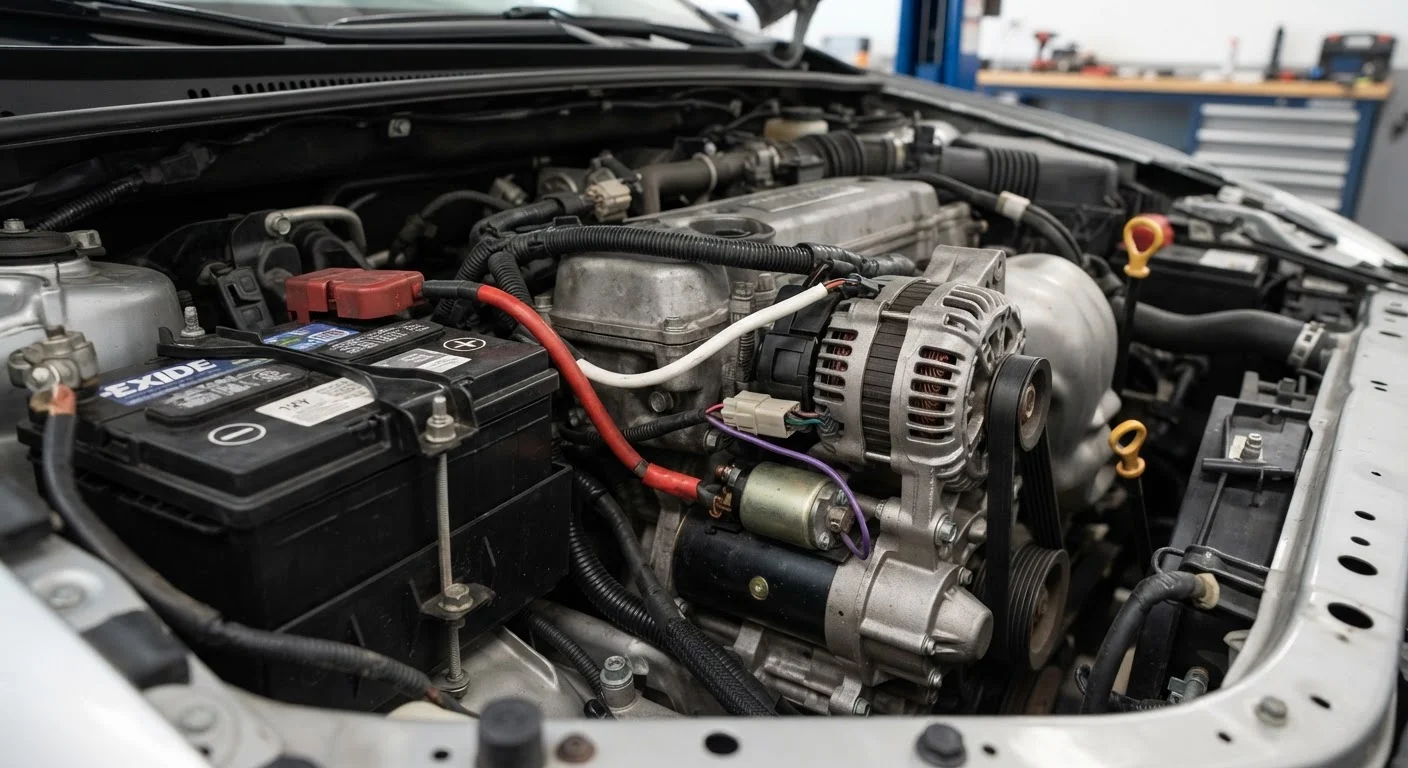
What Each Component Actually Does
Think of these three parts as a relay team. Each one has a specific job, and they hand off to each other in a precise sequence every time you start your car.
The Battery
The battery is your car's power reservoir. It stores electrical energy and delivers the burst needed to start the engine. It also powers everything when the engine isn't running - your headlights, interior lights, and electronics. Most car batteries are 12-volt lead-acid units and hold only enough charge to start the car a limited number of times without being recharged.
The Alternator
Once the engine is running, the alternator takes over. It converts mechanical energy from the engine into electricity, recharging the battery and powering all electrical systems while you drive. Without a working alternator, the battery slowly drains even with the engine on.
The Starter
The starter is a small but powerful electric motor. When you turn the key or press the ignition button, the battery sends current to the starter, which spins the engine fast enough to fire it up. Once the engine is running, the starter disengages automatically.
3-5 years
Typical car battery lifespan
Most manufacturers and mechanics cite this range, though climate extremes - particularly heat - can reduce it significantly.
80,000-150,000 mi
Typical alternator lifespan
Alternators are durable but do wear out; high electrical loads from accessories can shorten their service life.
~12.6 V
Healthy fully charged battery voltage
A reading below 12.4 volts at rest suggests the battery is partially discharged; below 12 volts typically indicates a weak or failing unit.
How Failure Shows Up
Because these three components are interdependent, symptoms can be misleading. Here's what to watch for:
- Won't start, no sound: Could be a completely dead battery, a blown fuse, or a failed starter relay.
- Single loud click, won't crank: Often points to a starter problem.
- Rapid clicking, won't crank: Usually means the battery is too weak to power the starter.
- Car starts but battery warning light is on: The alternator likely isn't charging properly.
- Dimming headlights while idling: Another sign the alternator is struggling to keep up.
- Slow, sluggish cranking: The battery may be weak, or the starter is drawing too much current.
One important caution: don't replace parts based on symptoms alone. A mechanic can test all three components with a multimeter and a battery load tester before any money is spent.
Test Before You Replace
It's tempting to replace the battery when your car won't start, but that can be an expensive guess. Ask a mechanic to test all three components - battery, alternator, and starter - before committing to a repair. Many auto parts stores also offer free battery and alternator testing, which can narrow things down quickly.
Keeping the System Healthy
Routine awareness goes a long way. Most car batteries last 3-5 years - if yours is in that range and you notice slow starts, it's worth having it tested. Many shops do this at no charge.
Short trips are harder on batteries than long ones because the alternator doesn't have enough run time to fully recharge the battery. If most of your driving is under 15 minutes, consider a periodic longer drive or ask your mechanic about your battery's state of charge.
Alternators and starters generally don't require scheduled maintenance, but they do wear out. An alternator typically lasts 80,000-150,000 miles; starters often reach similar mileage. If your car is high-mileage and you're diagnosing electrical issues, age is a relevant factor.
For drivers new to managing vehicle upkeep, our practical guide to car ownership covers the basics of keeping your vehicle dependable over the long term.
Frequently Asked Questions
If your car starts fine but the battery warning light stays on or lights dim while driving, the alternator is likely the culprit. If the car won't start at all and the battery is old, start there. A mechanic can test both in minutes with a simple diagnostic tool.
Most car batteries last between 3 and 5 years, though extreme heat or cold can shorten that. Many auto parts stores will test your battery for free, which is worth doing if your car is slow to start or the battery is approaching that age range.
Yes. A failing alternator that isn't recharging the battery properly will drain it, even a brand-new one. Replacing the battery without fixing the alternator means you'll likely end up stranded again within days.
A single loud click usually points to the starter. Rapid clicking often means the battery doesn't have enough charge to turn the engine over. Jump-starting can confirm whether it's a battery issue, but get a full diagnosis before assuming which part needs replacing.
Swapping a battery is one of the more approachable DIY tasks for most vehicles, though some modern cars have battery management systems that require a technician to reset after replacement. See our <a href="/automotive/car-maintenance/diy-car-maintenance-vs-taking-it-to-a-mechanic">guide on DIY vs. mechanic tasks</a> for help deciding.
The content on this site is for informational purposes only and is not a substitute for professional advice. Always consult a qualified professional for guidance specific to your situation.