

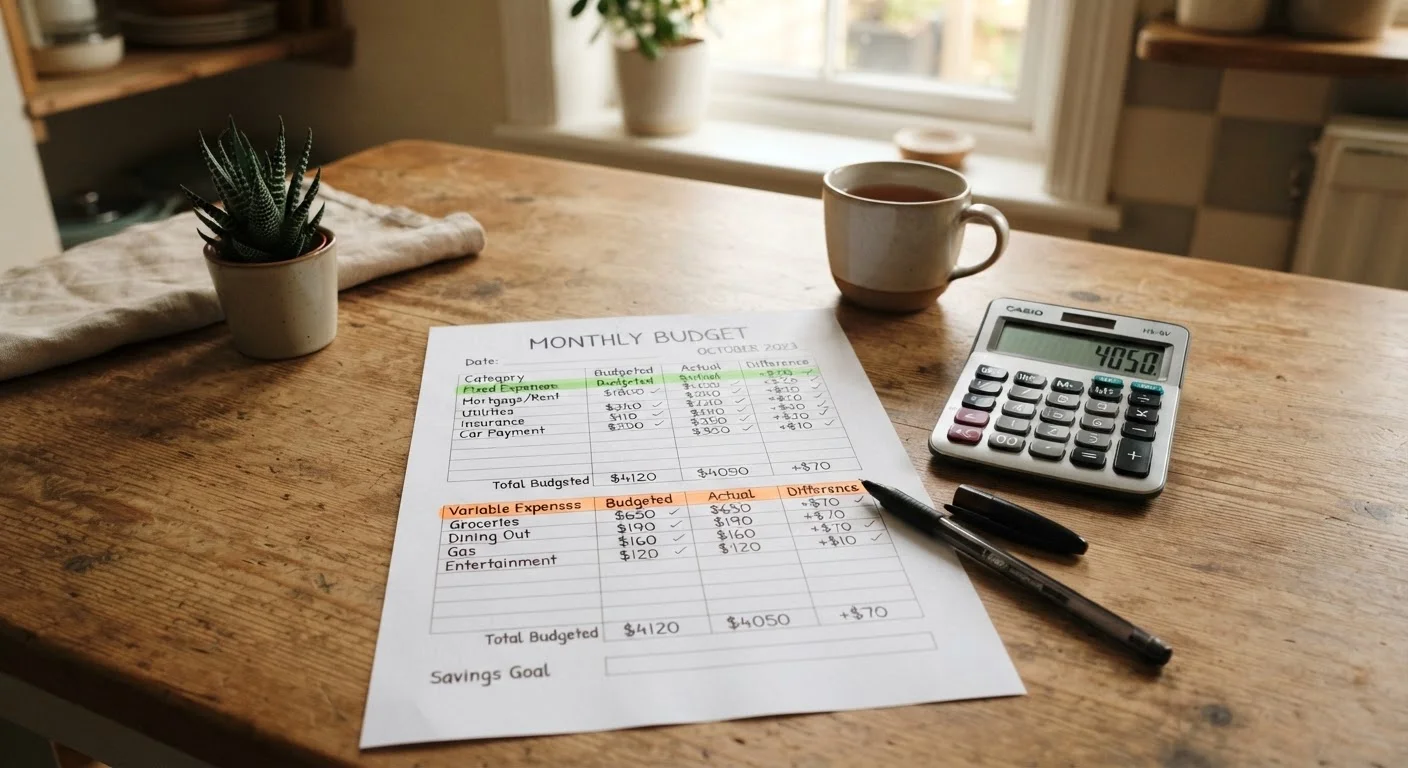
Option A
Fixed Expenses
The predictable, non-negotiable costs that stay constant each month.
Best for: Forming the foundation of any budget because their amounts are known in advance.
Option B
Variable Expenses
The flexible costs that shift from month to month based on your behavior.
Best for: Finding room to cut spending when money gets tight, since the amounts can change.
What Makes an Expense Fixed or Variable?
A fixed expense is any cost that stays the same amount every billing cycle regardless of how much you use or how you behave. Your rent or mortgage payment is the classic example - it's the same number every month. Car loan payments, renters or homeowners insurance premiums, and monthly subscription services at a set price all fall into this category. You can plan around them because they don't surprise you.
A variable expense changes from month to month. Groceries, gasoline, dining out, clothing, and entertainment are all variable - what you spend depends on your choices and circumstances. Variable costs are harder to predict but, critically, they're also the most responsive to your decisions. If cash is tight one month, you can eat at home more often. You can't negotiate your way to a lower rent payment that easily.
Understanding the key budgeting terms behind these categories is a useful starting point before you build your first real spending plan.
What About Semi-Variable Expenses?
Some costs don't fit neatly into either category. Utility bills, for example, carry a fixed base charge but fluctuate with usage. Cell phone plans with overage fees work the same way. For budgeting purposes, treat these as variable and use a monthly average based on past bills. Building in a small buffer above that average helps absorb months when usage spikes.
Side-by-Side: How the Two Types Compare
Putting both expense types next to each other makes the core differences easy to see at a glance. The table below covers the dimensions that matter most when you're building a budget.
| Criterion | Fixed Expenses | Variable Expenses |
|---|---|---|
| Amount each month | Stays the same | Changes based on behavior |
| Predictability | High - easy to plan around | Low to moderate |
| Control you have | Limited once committed | High - can adjust anytime |
| Common examples | Rent, car loan, insurance | Groceries, gas, dining out |
| Where to cut when tight | Difficult without major life change | Usually the first place to look |
| Budget approach | List exact known amounts | Use averages, then track closely |
One detail worth noting: some costs sit in a middle zone. Utilities - electricity, water, gas - have a base charge (fixed) but your total bill rises or falls with usage (variable). These are sometimes called semi-variable expenses. Budget for them using an average drawn from three to six months of past bills, then adjust if a season runs higher than usual.
Common Budgeting Mistakes Tied to Expense Type
Most budget breakdowns come down to one of two errors: underestimating variable costs or ignoring irregular fixed costs.
Underestimating variable costs is nearly universal. People budget $300 for groceries and spend $420 without noticing why. Variable expenses are emotionally easier to minimize in our heads because each individual purchase feels small. The solution is to track actual spending for at least two months before setting a budget number - let reality set the baseline, not optimism.
Forgetting irregular fixed costs is just as damaging. Annual expenses like car registration, insurance renewals, or yearly software subscriptions are technically fixed - they don't vary - but they don't appear every month. Divide these annual amounts by 12 and set that amount aside monthly so the bill doesn't blindside you. This is sometimes called a sinking fund approach.
For a closer look at which categories consistently catch households off guard, see spending categories that quietly blow most budgets.
How to Apply This in a Real Budget
The practical step is simple: grab three months of bank and credit card statements and sort every line item into one of three columns - fixed, variable, or irregular fixed. Once you've done that, two things become immediately clear: what your unavoidable monthly floor is, and where your spending is discretionary.
Your unavoidable monthly floor - the sum of all fixed expenses - is the number your income must exceed. Everything above that floor is what you have to work with for variable costs and savings. If that gap feels uncomfortably small, you know the problem is either income-side or you have too many fixed commitments relative to what you earn.
From there, set realistic caps on your variable buckets using your actual historical spending, not a wishful estimate. Reviewing those caps once a month keeps the plan honest. The habits that separate consistent budgeters from those who drift almost always include this kind of regular check-in.
If you're ready to choose a budgeting method that fits your lifestyle, zero-based budgeting versus the 50/30/20 rule walks through two of the most practical frameworks side by side.
This article is for general informational and educational purposes only and does not constitute personalized financial advice. Consider speaking with a qualified financial professional about decisions specific to your situation.
The content on this site is for informational purposes only and is not a substitute for professional advice. Always consult a qualified professional for guidance specific to your situation.