

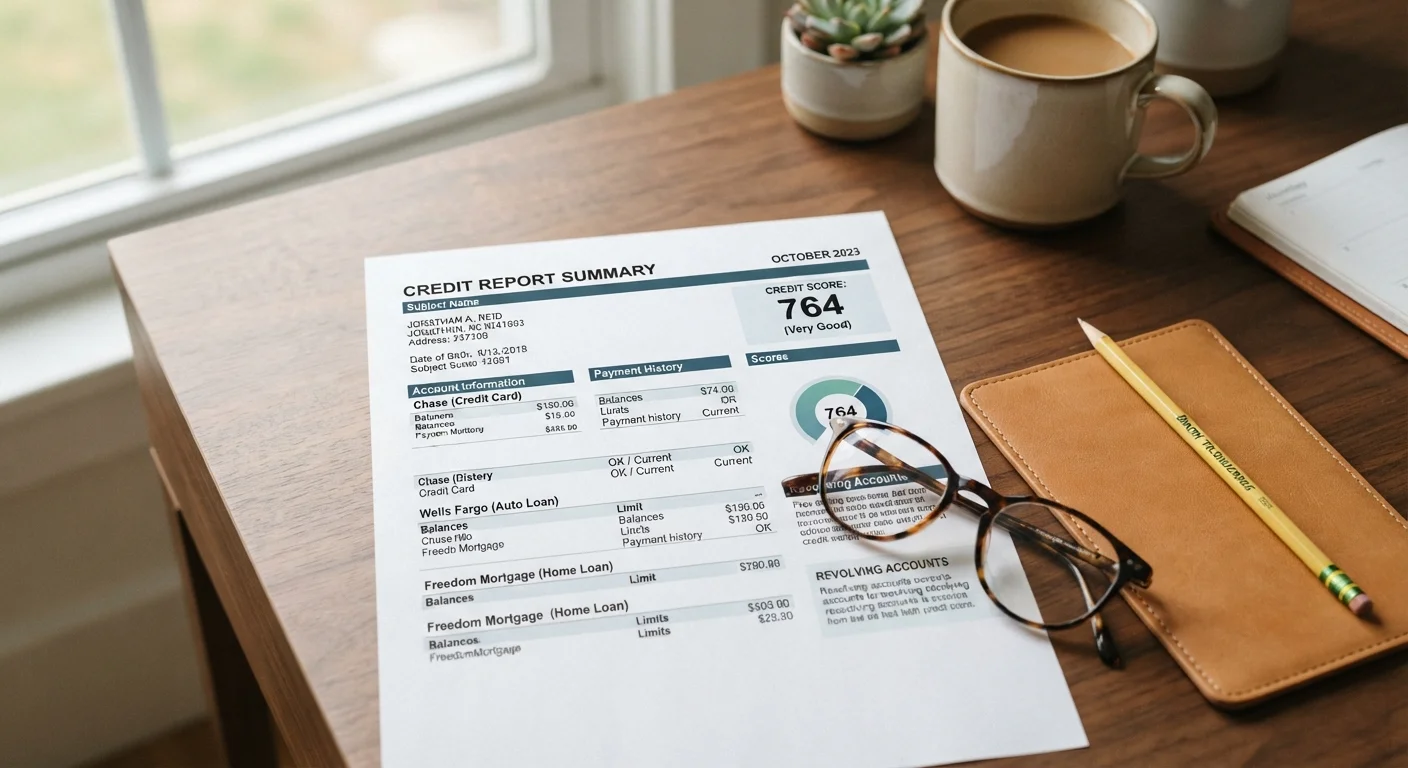
What a Credit Report Actually Is
Your credit report is a detailed record of how you've handled borrowed money over time. It's maintained by three major credit bureaus - Equifax, Experian, and TransUnion - and draws from lenders, credit card companies, and other creditors who report your activity to them.
It's important to separate the report from your credit score. The report is the raw data: account histories, payment records, balances, and public records. Your credit score is a number calculated from that data. Think of the report as your financial transcript and the score as your GPA. To understand the score, you need to understand what feeds into it - start with our overview of what your credit score is actually made of.
Under federal law, you're entitled to one free report per year from each bureau through AnnualCreditReport.com. That means you can space them out - one bureau every four months - to monitor your file throughout the year at no cost.
1 in 5
Americans with credit report errors
A Federal Trade Commission study found that approximately one in five consumers had an error on at least one of their three credit reports.
3
Major credit bureaus reporting your data
Equifax, Experian, and TransUnion each maintain separate files, so your reports may differ slightly across all three.
7 years
How long most negative items remain
Late payments, collections, and most other negative marks generally stay on your credit report for seven years from the date of the original delinquency.
The Five Main Sections Explained
1. Personal Information
This section lists your name, current and past addresses, date of birth, Social Security number (partially masked), and employers. It doesn't affect your score, but it's worth checking for accuracy. A name misspelling or an address you don't recognize could signal a data mix-up or fraud.
2. Account Information (Trade Lines)
This is the largest section and the most important. It lists every credit account - credit cards, mortgages, auto loans, student loans - with details like the date opened, credit limit or loan amount, current balance, and payment history. Each account is marked as open or closed, and any late payments are noted by how many days overdue (30, 60, 90, or 120+ days).
3. Credit Inquiries
When you apply for credit, lenders pull your report - this is called a hard inquiry. Hard inquiries stay on your file for two years and can slightly lower your score temporarily. Soft inquiries - like when you check your own report or a company pre-screens you for an offer - don't affect your score at all.
4. Public Records
This section used to include tax liens and civil judgments, but those were removed from consumer credit reports in 2018. Today, bankruptcies are the primary public record you'll find here. A Chapter 7 bankruptcy stays on your report for 10 years; Chapter 13 stays for 7 years.
5. Collections
If a debt was sent to a collection agency, it appears here separately from the original account. Collections can significantly damage your score. Even paid-off collections may remain visible, though some newer scoring models weigh them less heavily once resolved.
When reviewing your trade lines, focus first on any account you don't recognize - an unfamiliar account is often the earliest sign of identity theft or a bureau mix-up.
Catching an unauthorized account early limits the damage it can do to your score and simplifies the dispute process before a lender ever sees it.
Request reports from each bureau on a rotating schedule - one every four months - rather than all three at once, so you have a more current view of your file year-round.
Because bureaus update independently and creditors don't always report to all three, spacing your reviews increases the chances of catching a problem closer to when it appears.
How to Spot Errors and What to Do About Them
Studies have found that a meaningful share of credit reports contain at least one error - ranging from a wrong account balance to an account that doesn't belong to you at all. Common problems include: duplicate accounts listed twice, payments marked late when they were on time, accounts belonging to someone with a similar name, and accounts still showing a balance after being paid off.
Don't Ignore Accounts You Don't Recognize
An account you didn't open appearing on your credit report is a serious red flag that should be investigated immediately - not ignored. It could indicate identity theft, a reporting error, or a mixed file where someone else's data has been merged with yours. Disputing it promptly with the relevant bureau is the right first step. You may also want to place a fraud alert or credit freeze on your file while you investigate.
If you find something wrong, you can dispute it directly with the credit bureau that published the report. Each bureau has an online dispute portal, and you can also write a formal dispute letter. The bureau is generally required to investigate within 30 days and remove or correct information it can't verify. You can also contact the creditor that reported the error directly - fixing it at the source often resolves the issue across all three bureaus faster.
Keep records of everything you send and receive during a dispute. If the bureau sides with the creditor and you still believe the information is wrong, you have the right to add a brief consumer statement to your file explaining your position.
What Lenders Are Actually Looking At
When you apply for a loan or credit card, a lender doesn't just glance at your score - they pull your full report and look for specific signals. They're checking whether you pay on time consistently, how much of your available credit you're using (your credit utilization ratio), how long your accounts have been open, and whether you've recently applied for a lot of new credit at once.
A high balance relative to your credit limit can raise a flag even if you pay in full each month, because utilization is measured at the time the report is pulled - not after your next payment posts. This is one reason carrying lower balances between statements can help. For a plain-language breakdown of related terms, see our glossary of financial terms every consumer should know.
If you're planning to apply for a mortgage, your credit report carries even more weight. Lenders look at it closely to determine what loan programs you qualify for and at what interest rate. Our article on what your credit score does to your mortgage options explains how lenders interpret different score ranges.
How Often You Should Check Your Report
Checking your own credit report doesn't hurt your score - it counts as a soft inquiry. At minimum, reviewing each bureau's report once a year is a reasonable baseline. But if you're planning a major financial move like buying a home or a car, check all three reports several months in advance. That gives you time to dispute any errors before a lender sees them.
Regular review also helps you catch identity theft early. If an account you don't recognize appears, or if your personal information shows an address where you've never lived, that's worth investigating promptly. Our pre-application checklist walks through what to verify before submitting any credit application.
Reading a credit report for the first time can feel overwhelming - but once you know what each section means and what to look for, it becomes a practical tool rather than a mystery document. The information is yours, and understanding it puts you in a stronger position to manage your financial life.
This article is for general informational and educational purposes only and does not constitute personalized financial or legal advice. Consider consulting a licensed financial adviser for guidance specific to your situation.
The content on this site is for informational purposes only and is not a substitute for professional advice. Always consult a qualified professional for guidance specific to your situation.