

How the Three Buckets Actually Work
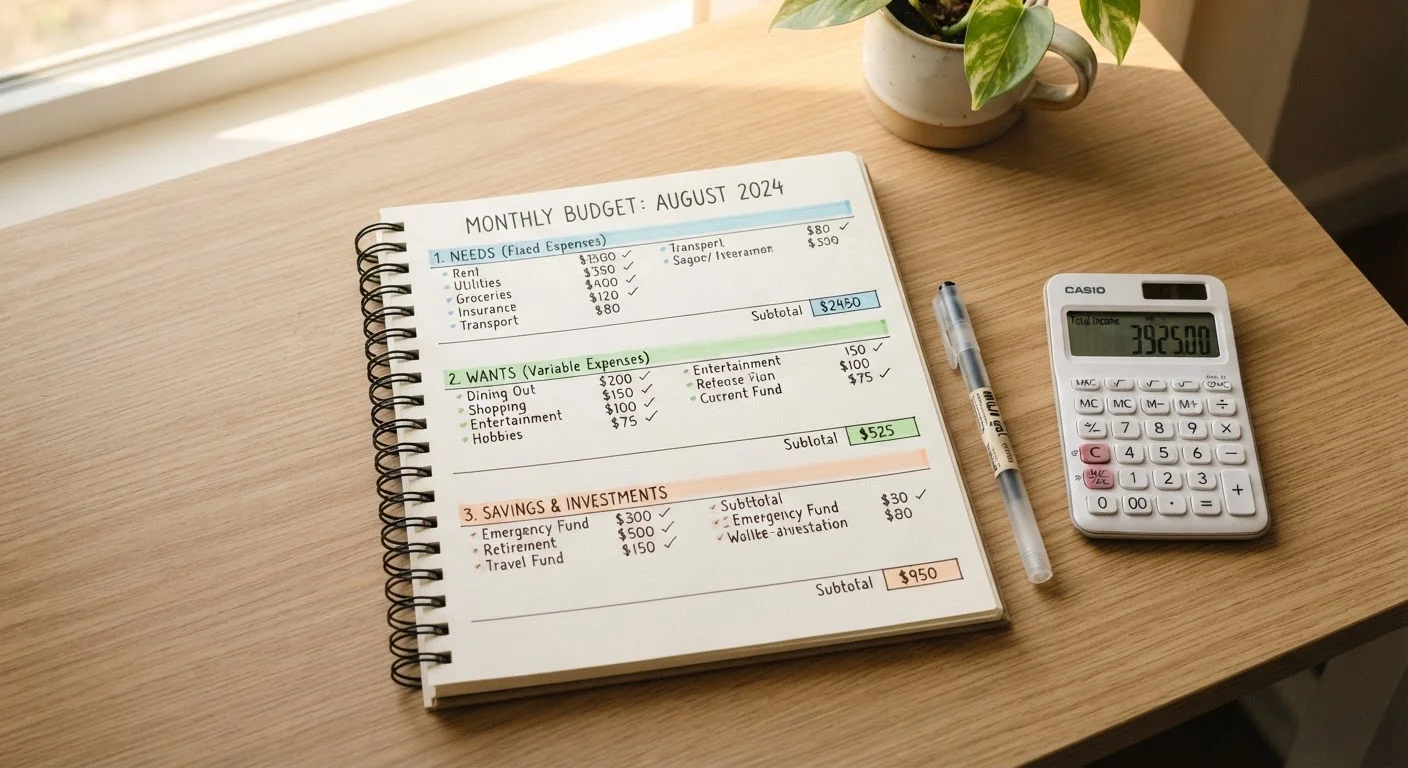
The 50/30/20 rule splits your monthly take-home pay into three broad categories. Here's what each one covers:
- 50% - Needs: Rent or mortgage, utilities, groceries, health insurance, minimum debt payments, and basic transportation. These are the bills you must pay to keep life running.
- 30% - Wants: Dining out, streaming services, vacations, hobbies, gym memberships. Things that improve your life but aren't strictly required.
- 20% - Savings and debt repayment: Emergency fund contributions, retirement savings, extra debt payments above the minimum, and other financial goals.
The simplicity is the point. Rather than tracking every coffee or gas fill-up, you monitor which bucket your spending falls into. For a deeper look at applying this to your paycheck, see how the 50/30/20 rule works in practice.
20%
Recommended share of income for savings and debt payoff
Under the 50/30/20 framework, one-fifth of take-home pay is directed toward financial goals and extra debt payments.
57%
Americans who say they couldn't cover a $1,000 emergency from savings
According to a Bankrate survey, a majority of U.S. adults would struggle to fund an unexpected expense, highlighting why building the emergency fund portion of the 20% matters.
3-6 months
Recommended emergency fund coverage
Financial educators broadly recommend holding three to six months of essential living expenses in accessible savings as a baseline safety net.
Where Savings Actually Land in This Framework
The 20% bucket is where savings live - but it does double duty. It also covers any debt payments beyond the required minimums. That means if you're carrying a credit card balance and putting $200 extra toward it each month, that $200 counts as part of your 20%, not your needs.
Within that 20%, most people have several competing priorities:
- Emergency fund (typically three to six months of essential expenses)
- Retirement contributions (401(k), IRA, or similar accounts)
- Sinking funds for predictable future expenses (car repairs, holiday gifts, annual insurance premiums)
- Long-term goals like a down payment or education costs
The order you tackle these in depends on your situation. A common starting point: cover a small starter emergency fund first, then capture any employer 401(k) match, then work on higher-interest debt before building savings further.
Automate Your 20% First
One of the most reliable ways to actually save 20% is to move the money before you see it. Set up an automatic transfer to a savings or retirement account on the same day your paycheck lands. When savings happen automatically, you're less likely to spend that money on wants before it reaches its intended destination.
When the Standard Percentages Don't Fit
The 50/30/20 split is a guideline, not a rule carved in stone. For many Americans - especially those in high-cost cities or earning lower wages - needs alone can consume 60% or more of take-home pay. That's a real constraint, not a budgeting failure.
In those cases, the framework still has value as a directional target. You might run a 65/20/15 split today with a plan to migrate toward 50/30/20 as income grows or fixed expenses drop (like when a car is paid off or a lease ends).
Minimum Debt Payments Belong in Needs
It's a common point of confusion: minimum required payments on debts (credit cards, student loans, car loans) count as needs, not as part of your 20%. Only the extra amount you pay beyond the minimum - the accelerated payoff portion - belongs in the savings and debt-repayment bucket. Getting this distinction right prevents you from undercounting your needs.
The reverse problem is also worth mentioning: if your needs are well under 50%, you have room to push more than 20% into savings. That flexibility is one of the rule's strengths. For a side-by-side comparison of other approaches, check out our look at zero-based budgeting vs. the 50/30/20 rule.
Making the Savings Habit Stick
Knowing where savings fit in the framework is one thing. Actually moving money there consistently is another. A few approaches that tend to hold up:
- Automate transfers: Set up automatic transfers to a savings account on payday so the money moves before you can spend it. This is the core of the pay-yourself-first approach.
- Use separate accounts: Keeping savings in a different account - ideally one that's slightly harder to access - reduces the temptation to tap it for everyday expenses.
- Name your goals: Labeling savings buckets ("emergency fund," "car repair," "vacation") makes abstract goals feel concrete and easier to stay motivated about.
For more tried-and-tested approaches, see savings strategies that hold up over time. If you want to understand where to park the money once you're saving consistently, common savings vehicles explained covers the basics of high-yield savings accounts, CDs, and money market accounts.
This article is for general informational purposes only and does not constitute personalized financial advice. Consider speaking with a qualified financial professional about decisions specific to your situation.
Frequently Asked Questions
Not necessarily. The 20% bucket covers savings and debt repayment beyond minimum payments. If you're paying down a credit card aggressively, that extra payment comes from this 20%. Once high-interest debt is cleared, more of that 20% can shift toward building savings.
Building an emergency fund is part of the 20% category. Financial educators commonly recommend working toward three to six months of essential expenses. You'd treat emergency fund contributions like any other savings goal within that slice.
Needs are expenses you can't reasonably avoid: rent or mortgage, utilities, groceries, basic transportation, health insurance, and minimum loan payments. Subscriptions, dining out, and entertainment fall under wants, even if they feel essential.
The rule may be harder to apply if your needs alone consume more than 50% of take-home pay - a common situation in high-cost areas. In that case, it can still serve as a directional guide while you adjust percentages to fit your reality. The goal is progress, not perfection.
Generally yes, though there's some nuance. Contributions to a 401(k) or IRA are savings goals, so they belong in the 20%. If your employer takes 401(k) contributions before your paycheck is issued, some budgeters add that amount back in to get an accurate picture of their full income and savings rate.
The 50/30/20 rule uses broad categories and requires less detailed tracking, making it easier to maintain. Zero-based budgeting assigns every dollar to a specific line item each month, which offers more precision but takes more effort. See a full comparison in our <a href="/finance/budgeting-basics/zero-based-budgeting-vs-the-503020-rule">zero-based vs. 50/30/20 breakdown</a>.
The content on this site is for informational purposes only and is not a substitute for professional advice. Always consult a qualified professional for guidance specific to your situation.