

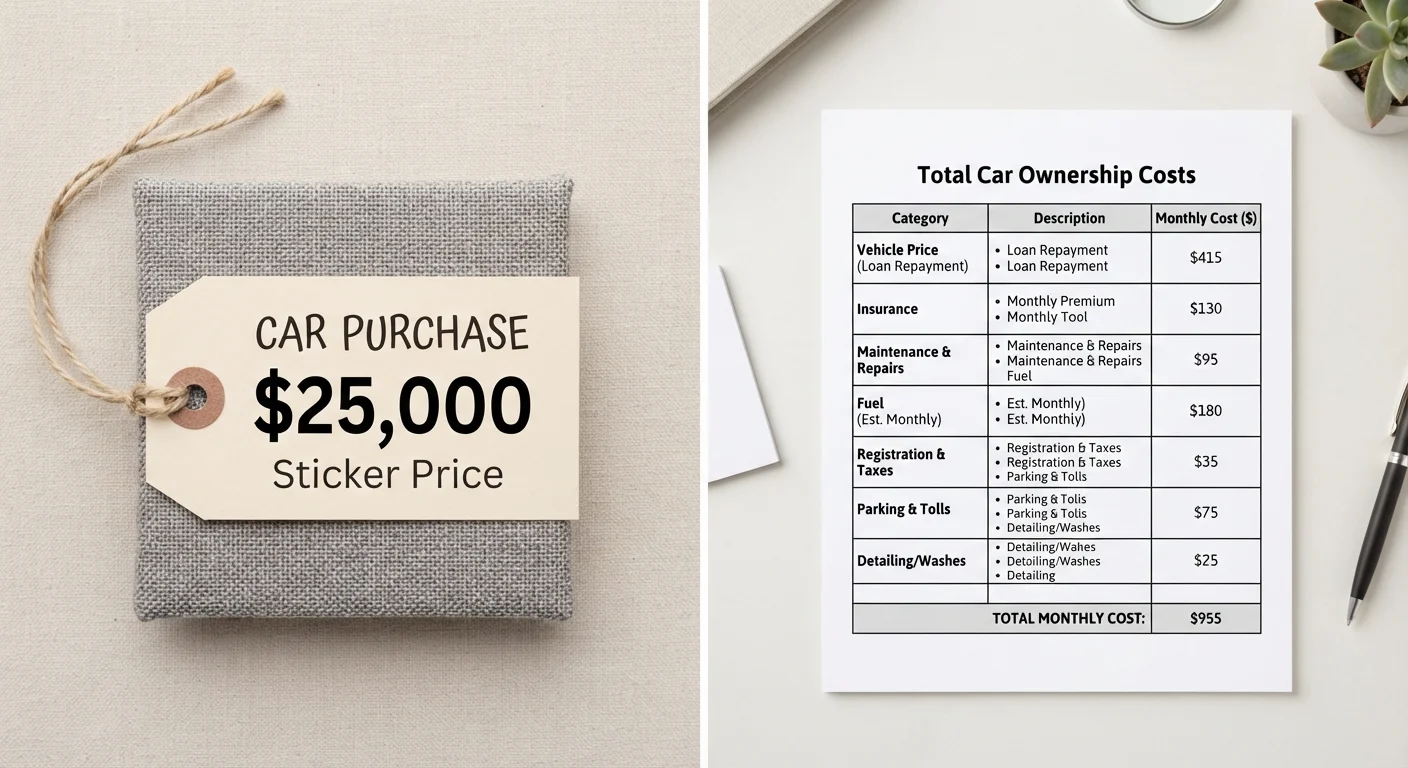
What Total Cost of Ownership Actually Means
When you see a price tag - on a car, an appliance, a phone, or a home - that number reflects only what you pay at the moment of purchase. Total cost of ownership (TCO) is the fuller picture: every dollar you'll spend to acquire, operate, maintain, and eventually dispose of something over its useful life.
TCO is not a new idea. Businesses have used it for decades to evaluate equipment purchases. But everyday consumers rarely apply it, which means a "cheaper" option often turns out to be the more expensive one after a year or two of use.
Total Cost of Ownership (TCO)
The complete cost of purchasing and operating an item over its useful life, including acquisition, operating, maintenance, insurance, and disposal costs. It provides a more accurate comparison than sticker price alone.
Operating Cost
Recurring expenses required to use an item - such as fuel, electricity, or subscription fees. These costs accumulate over time and can exceed the purchase price for long-lived assets.
Depreciation
The decline in an asset's value over time due to age, wear, or obsolescence. High depreciation reduces the resale value you can recover at the end of ownership.
Residual Value
The estimated worth of an item at the end of a defined ownership period. A higher residual value lowers the net total cost of ownership.
Maintenance Reserve
Money set aside in advance to cover routine upkeep and unexpected repairs. Planning for this prevents surprise expenses from disrupting a budget.
This framework applies broadly. Renting a home comes with costs that go well beyond monthly rent, just as buying a car involves far more than the dealer's asking price. Understanding TCO helps you compare apples to apples.
The Core Components of TCO
TCO breaks down into several categories that vary by product type, but the structure is consistent across most purchases:
| What TCO measures | All costs from purchase through disposal |
| Key cost categories | Purchase, operating, maintenance, insurance, subscriptions, disposal |
| Common ownership period for vehicles | 5-8 years (varies by owner) |
| Typical appliance lifespan | 10-15 years for major appliances (U.S. Department of Energy general guidance) |
| Depreciation impact - new vehicles | Vehicles often lose 15-25% of value in the first year (General industry estimates; varies by model and market) |
| Subscription cost risk | Recurring fees can add hundreds annually per device |
- Purchase price: The upfront cost, including taxes, fees, and financing charges. If you borrow money, interest adds meaningfully to what you actually pay.
- Operating costs: Fuel, electricity, water, or data consumption - whatever the item requires to run. These recur constantly and compound over time.
- Maintenance and repairs: Routine upkeep (oil changes, filter replacements, software updates) plus unplanned repairs. Reliability records matter here.
- Insurance and warranties: Required or optional coverage that protects against loss. These are real costs even when nothing goes wrong.
- Subscriptions and add-ons: Many devices and services now carry recurring fees - streaming bundles, cloud storage, connected-car plans - that didn't exist a decade ago.
- Resale or disposal value: What you recover (or spend) when you're done. Some items depreciate sharply; others hold value or carry disposal fees.
Omitting even one of these categories can lead to a decision that looks smart on day one but costs significantly more over three to five years.
Where TCO Changes the Outcome Most
TCO comparisons tend to flip the apparent winner in a few common spending categories:
Vehicles
Two vehicles priced similarly at the dealership can diverge by thousands of dollars annually once you account for fuel economy, insurance rates, scheduled maintenance intervals, and expected reliability. Focusing only on the monthly payment is one of the most common car-buying habits that leads to paying more than necessary. Running a five-year TCO estimate before you shop shifts the conversation considerably. See also: common dealership myths that can skew how buyers approach negotiating.
Appliances and Electronics
An energy-efficient appliance with a higher sticker price may cost less to run each month. Over a decade, those utility savings can more than offset the purchase premium. Similarly, a phone with a lower upfront price might require a costlier data plan or lack software support within two years, forcing an earlier replacement cycle.
Groceries and Everyday Goods
Unit pricing applies the TCO mindset to grocery shopping - revealing the real cost per ounce or serving rather than the package price. The same logic scales up: a bulk purchase isn't a deal if the product expires before you use it.
~$12,000
Average annual vehicle cost including depreciation, fuel, insurance, and maintenance
According to AAA's annual Your Driving Costs study, total ownership costs for an average new vehicle can reach roughly $12,000 per year depending on vehicle type and usage.
15-25%
First-year value loss on a new vehicle
Industry estimates suggest new vehicles commonly depreciate 15-25% within the first 12 months, making depreciation the single largest TCO component for many buyers.
1-2%
Common annual maintenance budget as share of purchase price
A widely cited rule of thumb for durable goods budgeting; actual costs vary significantly by product category and age.
Travel
Resort fees, airport parking, and currency conversion charges routinely inflate travel budgets well beyond the advertised fare or nightly rate - a textbook TCO gap.
How to Run a Simple TCO Estimate
You don't need a spreadsheet or financial background to estimate TCO. A back-of-the-envelope approach works for most consumer decisions:
- List the purchase price including taxes, delivery, and any financing costs.
- Estimate annual operating costs - fuel, electricity, subscriptions - and multiply by the years you expect to own the item.
- Add maintenance reserves. A common rule of thumb is to budget 1-2% of the purchase price annually for upkeep on durable goods, though this varies widely by category.
- Factor in insurance if applicable.
- Subtract the estimated resale or residual value at the end of the ownership period.
The resulting number is your estimated TCO. Compare it across options - not just the sticker prices - and the more durable or efficient choice often wins.
This article is for general informational and educational purposes only. It does not constitute personalized financial, legal, or investment advice. For decisions specific to your situation, consult a qualified financial professional.
The content on this site is for informational purposes only and is not a substitute for professional advice. Always consult a qualified professional for guidance specific to your situation.