

Start here
What Unit Pricing Actually Is
Next
How to Read a Unit Price Label
Go deeper
When Bigger Packages Are Not the Better Deal
Expand your skills
Unit Pricing Beyond the Grocery Aisle
Watch out for
Common Traps That Throw Off Your Comparison
What Unit Pricing Actually Is
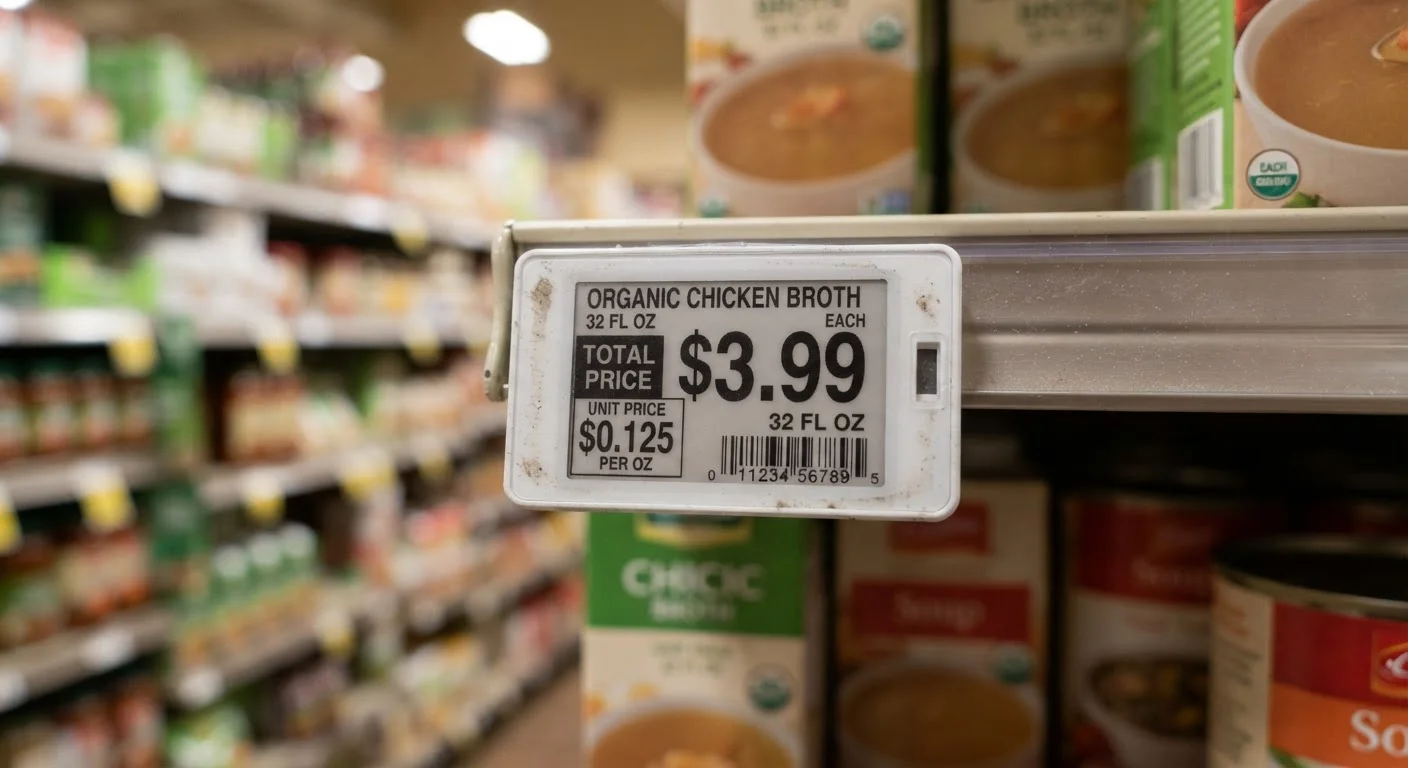
Most shoppers look at the big number on the price tag and move on. But buried in smaller print - usually at the bottom of the shelf label - is a number that does far more work: the unit price.
Unit price tells you what you're paying per standardized measure. Depending on the product, that measure might be per ounce, per fluid ounce, per pound, per 100 sheets, or per tablet. The idea is simple: instead of comparing a $4.29 bottle against a $5.99 bottle, you compare $0.18 per ounce against $0.15 per ounce. Suddenly the "cheaper" bottle isn't.
This skill fits squarely into the broader habit of spending intentionally. If you want to stretch your grocery dollars further - especially on pantry staples - unit pricing is one of the most direct levers available. It pairs naturally with strategies covered in our guide to smarter everyday spending.
Unit price
The cost of a product broken down to a single standard measure - such as per ounce, per pound, or per count - so you can compare differently sized packages fairly.
Net weight
The weight of the product itself, not counting the packaging. This is the number you use as the denominator when calculating unit price by weight.
Shelf label
The price tag attached to the store shelf edge below a product. In many stores this label includes both the total price and the unit price.
Bulk sizing
Large-format packaging - sometimes called club size or family size - that typically (but not always) offers a lower cost per unit than standard sizes.
Convenience premium
The extra cost built into products that save you time or effort, such as pre-cut vegetables or single-serve portions. Unit price will be higher, but may still be worth it depending on your priorities.
How to Read a Unit Price Label
Shelf labels differ by store, but most follow a common layout. The total price appears in large font. Somewhere nearby - often lower-left or lower-right - you'll find a smaller figure labeled "price per oz," "per unit," or something similar. That's your comparison number.
When labels are missing, inconsistent, or expressed in different units across competing products, calculate it yourself:
- Find the total price on the package or shelf tag.
- Find the quantity on the package (net weight, volume, or count).
- Divide price ÷ quantity.
Example: A 32-oz bottle of dish soap costs $3.84. Divide $3.84 ÷ 32 = $0.12 per oz. A 20-oz bottle costs $2.60. That's $2.60 ÷ 20 = $0.13 per oz. The larger bottle wins - by a penny per ounce, but across a full year of purchases, those pennies compound.
One catch: make sure you're dividing by the same type of unit. Don't compare price-per-ounce against price-per-pound without converting first (16 oz = 1 lb).
Keep a Calculator App Handy
Your phone's built-in calculator turns any shelf into a fair comparison. Get in the habit of a quick price ÷ quantity check before reaching for the larger size automatically. It takes under 10 seconds and pays off every shopping trip.
When Bigger Packages Are Not the Better Deal
The assumption that warehouse-size or "family-size" packaging always saves money is widespread - and often wrong. Retailers know shoppers hold this belief, and pricing doesn't always reward it.
A few situations where the larger size loses on unit price:
- Sale pricing on smaller sizes: When a standard-size product is on sale and the bulk size is not, the sale item can beat it on unit price. Our article on sale price math explains how to check whether a marked-down price is genuinely cheaper.
- Store brands vs. name brands in large sizes: A name-brand club-store pack sometimes costs more per unit than a store-brand regular-size version. See our breakdown of store brand vs. name brand decisions for context.
- Perishable items you won't finish: A 5-lb bag of produce at a great unit price is no bargain if half goes in the trash. Factor in realistic usage before committing to bulk.
The bottom line: unit price tells you the math; your household habits tell you whether that math holds in practice.
Unit Pricing Beyond the Grocery Aisle
The same division that works on cereal works on nearly any product sold by a measurable quantity:
- Paper products: Paper towels and toilet paper are almost always labeled by sheet count or square footage - compare on that basis, not pack price.
- Cleaning supplies: Laundry detergent can be compared per load; dish soap per ounce.
- Personal care: Shampoo, body wash, and lotion are straightforward per-ounce comparisons.
- Pet food: Dry food compares well per pound; wet food per ounce or per can.
Where unit pricing gets complicated is with convenience premiums. Pre-cut vegetables, single-serve snacks, or ready-made meals have higher unit prices partly because preparation time is baked in. That's not necessarily irrational - but it should be a conscious trade-off. Our piece on the real cost of convenience walks through where those premiums tend to be steepest.
Also worth noting: when shopping for groceries with nutrition in mind, unit price can work alongside reading the nutrition label. Knowing cost-per-serving alongside nutrient content helps you find foods that are genuinely economical. Our healthy eating on a budget article covers affordable, nutrient-dense staples worth benchmarking.
Common Traps That Throw Off Your Comparison
A few reliable obstacles will try to derail an otherwise clean unit-price comparison:
- Mixed units on the shelf
- One product's label shows price per ounce; the one next to it shows price per pound. Multiply the per-ounce figure by 16 to convert, or divide the per-pound figure by 16, before comparing.
- "Per serving" vs. "per ounce" labeling
- Serving sizes are set by manufacturers and vary widely. Two cereals might both display price per serving, but if one serving is 28g and the other is 55g, you're not comparing equivalent amounts. Switch to per-ounce or per-gram for a fair look. Our guide to reading a nutrition facts label explains serving size definitions in plain terms.
- Anchoring on the original price
- A "was $8.99, now $6.49" label nudges you to see the current price as a deal regardless of what the unit math shows. That psychological effect - anchoring - is covered in our article on anchoring bias.
- Multi-buy promotions
- "3 for $5" feels automatic, but verify: is the per-unit price actually lower, or is the store just bundling at the standard price? And do you need three?
Don't Let Labels Do All the Thinking
Unit price labels are generated by store systems and can occasionally contain errors - especially after a price change or during a sale. If a number looks surprisingly low or high, double-check it with your own calculation before assuming the label is correct.
This article is for general informational and educational purposes. It does not constitute personalized financial advice. Consult a qualified financial professional for guidance specific to your situation.
Frequently Asked Questions
Unit price is the cost broken down to a standard measure - typically per ounce, per pound, per count, or per serving. It lets you compare two differently sized packages on equal footing without doing mental math on the full price.
Divide the total price by the quantity (weight, volume, or count) listed on the package. For example, a $3.60 jar containing 18 ounces works out to $0.20 per ounce. A basic phone calculator handles this in seconds.
Not always. Retailers sometimes price larger sizes at a higher per-unit cost, especially on sale items or store-brand products. Always check the unit price rather than assuming size equals savings.
Unit pricing requirements vary by state. Some states mandate it; others don't. When labels are absent or inconsistent, you can calculate it yourself using the total price and the package size.
Yes. The same math applies to paper towels, laundry detergent, shampoo, pet food, and many other household products sold by weight or count. Any product with a measurable quantity can be compared by unit price.
Frequently, yes. Store-brand products often carry a lower unit price than name-brand equivalents. Whether the quality difference matters is a separate question worth weighing case by case.
The content on this site is for informational purposes only and is not a substitute for professional advice. Always consult a qualified professional for guidance specific to your situation.