

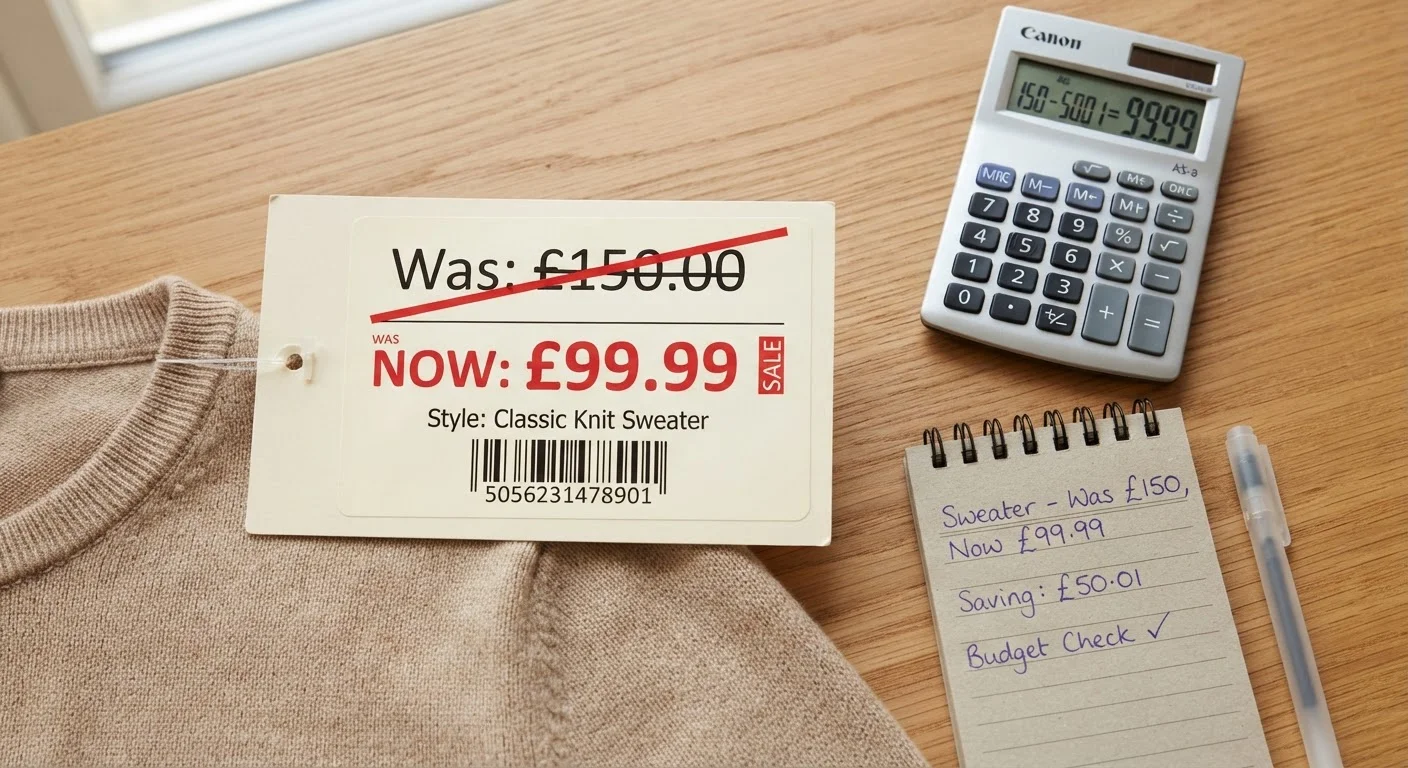
Why Sale Math Is Worth Learning
Retail pricing is designed to feel intuitive, but the signals retailers send - big red tags, crossed-out numbers, "limited offer" banners - are chosen to prompt quick decisions, not careful math. In practice, three types of deals cover the vast majority of what you'll encounter: percentage-off markdowns, multi-buy promotions like BOGO, and bundled packages. Each one uses a different structure, and each can obscure what you're genuinely paying.
The good news is that the math behind every one of these is simple enough to do in under a minute. You don't need a finance background - just a clear formula and the habit of using it. The steps below walk you through each format in order of how often most shoppers encounter them.
What you will need
For a broader look at how purchase price compares to long-term costs, see our piece on total cost of ownership.
Running the Numbers: Step-by-Step
Follow these steps in sequence when you encounter any promotion. You only need the steps relevant to the deal type in front of you - if it's a straight percentage off, steps 1 and 4 are your primary tools. If it's a bundle, step 3 is where most of the work happens.
Calculate the actual dollar amount saved on a percentage-off deal
Multiply the original price by the discount percentage expressed as a decimal. A 30% discount on a $40 item: $40 × 0.30 = $12 saved. Your out-of-pocket cost is $40 − $12 = $28. Always verify the original price is real - retailers occasionally inflate it before marking it down.
Find the true per-unit cost in a BOGO or multi-buy offer
"Buy one get one free" means you pay one price for two items. Divide the price you pay by the number of units you receive: Total price ÷ Total units = Cost per unit. Example: BOGO on a $6 item gives you 2 units for $6, so each costs $3. Compare that per-unit figure to the regular single-item price elsewhere before deciding it's a deal.
Evaluate a bundle deal by pricing items individually
List every item in the bundle. Look up what each costs when purchased separately. Add those individual prices together and compare the sum to the bundle price. The difference is your maximum possible saving - but only if you planned to buy every item anyway. Items you didn't need have a value of $0 to you, regardless of their listed price.
Spot an anchoring trap by questioning the reference price
Retailers know that the first number you see becomes your mental baseline - a concept called anchoring. A $200 item marked down to $120 feels like a $80 saving, but only if $200 was ever a real market price. Search for the item at two or three other retailers. If $130 is the normal going price, the $120 "sale" is a modest $10 saving, not an $80 one. Our article on anchoring bias explains the psychology in more detail.
Factor in fees and conditions that affect the final price
Some sale prices come with conditions: a required membership, a mail-in rebate, a minimum purchase threshold, or a service fee at checkout. Calculate the total you will actually pay - including any add-ons - and compare that to the baseline price without conditions. A sale price that requires a $50 annual membership to access may not outperform a slightly higher everyday price at a fee-free store. Hidden fees can quietly erase a discount before you even get home.
Inflated Original Prices Are Real
Some retailers mark up an item before putting it on sale so the discount looks more dramatic. If an item has been "on sale" for weeks without interruption, the sale price may effectively be the everyday price. Check a price-tracking resource or search for the item elsewhere before assuming a discount is meaningful.
Once you've confirmed the effective per-unit or net price, compare it to what you'd find at a different retailer or in a store-brand alternative. Sometimes the "sale" price on a name brand still costs more than the everyday price on a comparable generic.
Keep the Math Simple on Your Phone
Your phone's calculator handles every formula in this guide in seconds. Before checking out, take 30 seconds to verify the per-unit cost or effective discount. That habit alone can catch pricing that doesn't add up. For grocery shopping specifically, unit pricing labels do the division for you - if you know how to read them.
Spending More to Save More Is Still Spending More
A deal that requires you to buy three units when you only need one isn't a saving - it's a larger purchase. Calculate the true value based only on what you would have bought anyway. If you wouldn't have bought the extra item at full price, the "saving" doesn't count.
If you're making a larger purchase - like a vehicle - the same principles apply at a bigger scale. Understanding how reference prices work can also help when negotiating at a dealership.
The content on this site is for informational purposes only and is not a substitute for professional advice. Always consult a qualified professional for guidance specific to your situation.