

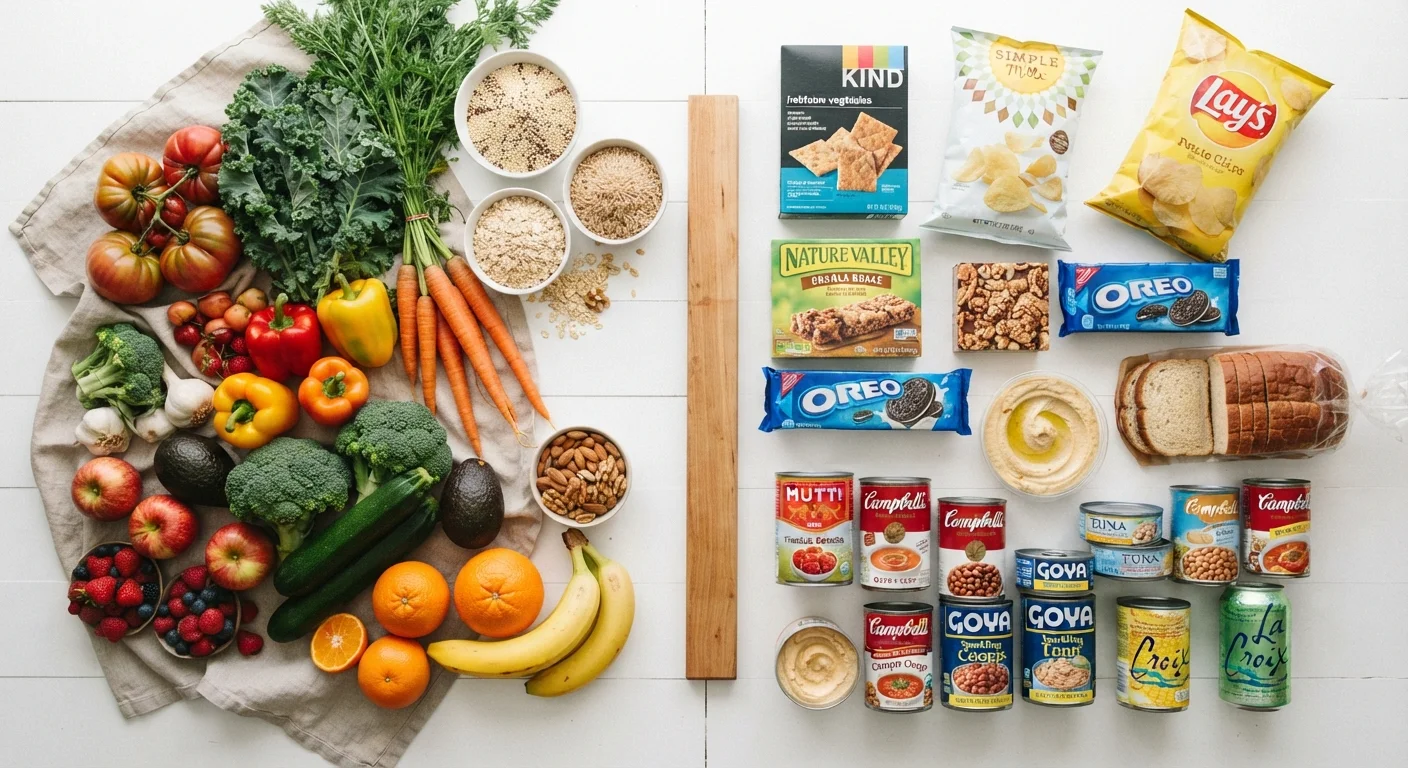
Option A
Whole Foods
Foods in their natural or minimally altered state.
Best for: People prioritizing nutrient density, fiber intake, and long-term dietary quality.
Option B
Processed Foods
Foods altered from their original form through industrial or culinary methods.
Best for: Convenience-focused consumers, though nutritional impact varies widely by processing level.
What Food Processing Actually Means
The word "processed" is applied so broadly in nutrition conversations that it has lost much of its precision. Technically, any food that has been washed, cut, cooked, frozen, canned, or combined with other ingredients has undergone some form of processing. That definition would include your morning oatmeal and a bag of fluorescent cheese puffs - clearly not equivalent foods.
A more useful framework comes from the NOVA classification system, developed by Brazilian nutrition researchers and widely cited in public health literature. NOVA divides foods into four groups based on the extent and purpose of industrial processing:
- Group 1 - Unprocessed or minimally processed foods: Fresh fruit, plain vegetables, eggs, unsalted nuts, plain whole grains, and fresh meat. These are foods in their natural state or with minimal intervention (drying, chilling, pasteurizing).
- Group 2 - Processed culinary ingredients: Oils, butter, flour, salt, and sugar used in cooking. Not typically consumed alone.
- Group 3 - Processed foods: Items made by adding Group 2 ingredients to Group 1 foods - canned beans in brine, cheese, smoked fish, simple breads. Altered, but recognizable.
- Group 4 - Ultra-processed foods (UPF): Industrial formulations made mostly from extracted or synthesized substances - colors, emulsifiers, flavor enhancers, hydrogenated fats, high-fructose syrups - with little or no whole food content.
Most nutrition concerns center on Group 4. When researchers or health organizations warn about processed food, they are typically referring to this ultra-processed tier.
How Each Category Stacks Up Nutritionally
The nutritional gap between a fresh apple and an apple-flavored snack cake is obvious. But what about less clear-cut comparisons - plain canned tomatoes versus fresh, or a store-bought whole-wheat loaf versus home-baked bread?
| Criterion | Whole Foods | Ultra-Processed Foods |
|---|---|---|
| Fiber content | Naturally high | Usually low or absent |
| Added sugars | None added | Often significant |
| Sodium | Naturally low | Frequently high |
| Micronutrient retention | Largely intact | Reduced; sometimes re-added synthetically |
| Shelf life | Shorter | Extended via preservatives |
| Satiety per calorie | Generally higher | Often lower |
| Ingredient list length | Minimal (1-5 ingredients) | Often lengthy with additives |
Research published in journals including BMJ and JAMA Internal Medicine has found consistent associations between high ultra-processed food consumption and elevated risks of obesity, type 2 diabetes, cardiovascular disease, and certain cancers. These are observational studies, meaning they show correlation rather than direct causation, and diet is notoriously difficult to isolate as a single variable. Still, the consistency of findings across large cohorts in multiple countries is notable.
Whole foods tend to deliver nutrients within a complex matrix - fiber, phytonutrients, water content - that affects how quickly they are digested and how satisfying they feel. Ultra-processed foods, by contrast, are often engineered to be calorie-dense and easy to overconsume, with additives that may affect gut microbiome composition, though research here is still developing.
For a deeper look at how protein sources specifically compare, see our guide to animal vs. plant protein trade-offs.
57%
Share of U.S. calories from ultra-processed foods
A nationally representative dietary analysis published in BMJ Open estimated that ultra-processed foods account for more than half of daily caloric intake for many American adults.
10%
Fiber intake gap among American adults
The Dietary Guidelines for Americans identifies dietary fiber as a nutrient of public health concern, with most adults consuming only about half the recommended daily amount.
12%
Higher cardiovascular risk associated with UPF consumption
A large prospective cohort study published in The BMJ found each 10% increase in ultra-processed food consumption was associated with a 12% higher risk of cardiovascular disease.
Making Practical Choices Without Overhauling Your Pantry
Eating exclusively whole, unprocessed foods is neither realistic nor necessary for good health. The goal is to shift the balance - reducing reliance on ultra-processed foods while leaning on convenient, minimally processed options that still support nutritional needs.
A few principles that nutrition researchers and dietitians broadly support:
- Scan the ingredient list, not just the nutrition label. A short list of recognizable ingredients usually signals less processing. A long list of additives, modified starches, and synthetic flavors signals ultra-processing.
- Prioritize fiber. Whole foods - especially vegetables, legumes, whole grains, and fruits - are the primary dietary source of fiber, which supports digestive health and satiety. Most Americans consume well below the recommended daily amount.
- Don't dismiss minimally processed staples. Plain canned chickpeas, frozen spinach, and rolled oats are processed but nutritionally sound. They can anchor meals on a modest budget. For more on evaluating value at the grocery store, see our store brand vs. name brand comparison.
- Treat ultra-processed foods as occasional, not foundational. Enjoying chips or a packaged cookie occasionally is unlikely to undermine a generally nutritious diet. The concern is when UPFs make up the majority of daily calories.
Not All Convenience Foods Are Equal
Plain frozen vegetables, canned fish in water, plain yogurt, and dried legumes sit in the minimally processed category despite being packaged and shelf-stable. They are not the same as frozen meals loaded with additives or heavily sweetened yogurt cups. When time and budget are real constraints, these staples are a practical middle ground. Reading the ingredient list takes less than a minute and is the quickest way to assess where a product falls on the processing spectrum.
This article is for general informational and educational purposes only and does not constitute medical or dietary advice. Individual nutritional needs vary. Consult a registered dietitian or qualified healthcare provider for guidance tailored to your health circumstances.
The content on this site is for informational purposes only and is not a substitute for professional advice. Always consult a qualified professional for guidance specific to your situation.