

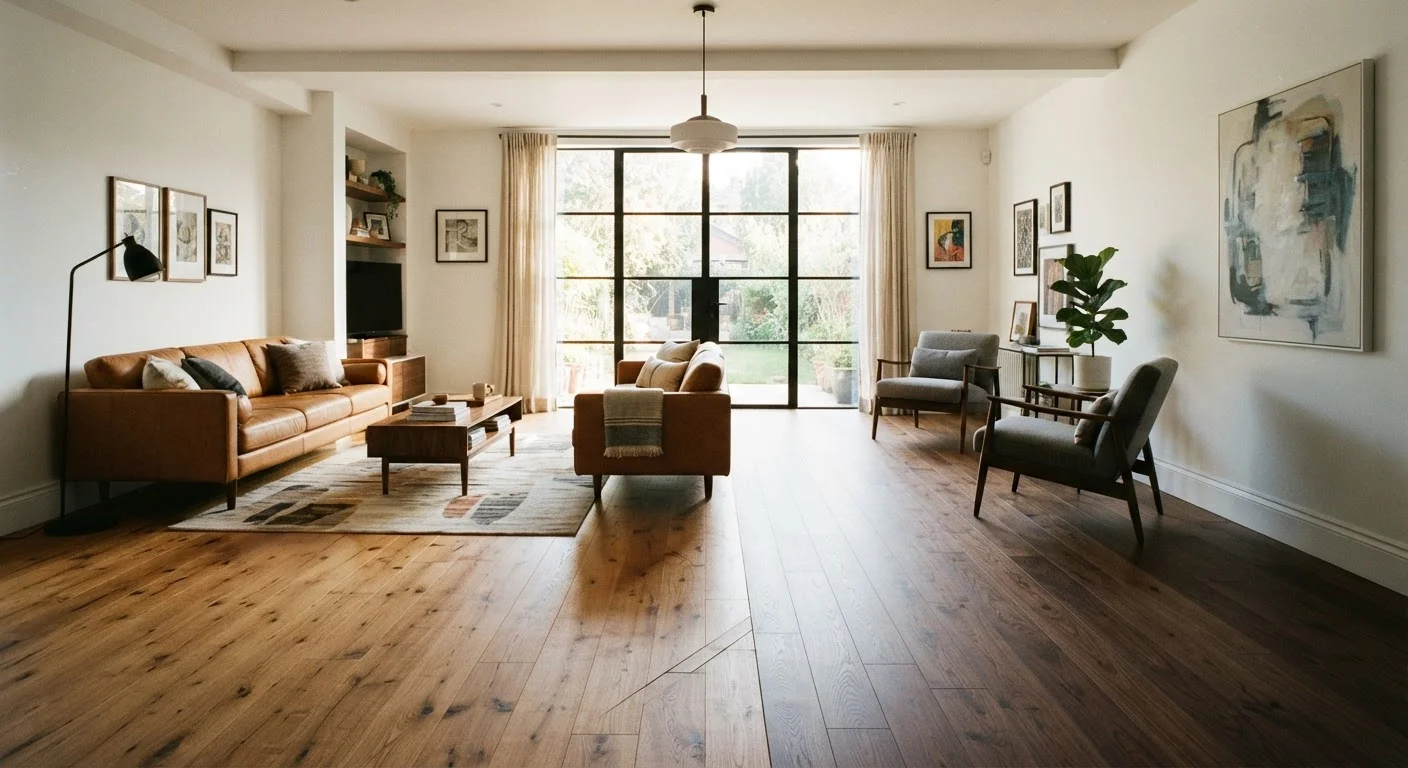
Option A
Solid Hardwood Flooring
The time-tested, refinishable classic.
Best for: Dry living areas where long-term character, refinishing potential, and resale appeal are top priorities.
Option B
Engineered Wood Flooring
The versatile, moisture-resilient modern alternative.
Best for: Homes with variable humidity, below-grade spaces, or rooms where solid wood would be too susceptible to moisture.
What Sets These Two Flooring Types Apart
At a glance, solid hardwood and engineered wood can look nearly identical once installed. The real differences lie beneath the surface - literally. Solid hardwood is milled from a single piece of wood, typically ¾ inch thick, and can be sanded back multiple times over its lifespan. Engineered wood features a real wood veneer on top, bonded to several layers of cross-directional plywood or high-density fiberboard (HDF) beneath. That layered core is what gives engineered wood its structural edge in challenging conditions.
The thickness of the top veneer on engineered wood varies - usually between 1 mm and 6 mm. Thicker veneers allow for one or two light sandings, while thinner ones are essentially single-use. If refinishing potential matters to you, check the veneer thickness before purchasing.
| Criterion | Solid Hardwood | Engineered Wood |
|---|---|---|
| Core composition | Single piece of milled wood | Wood veneer over plywood/HDF core |
| Typical thickness | ¾ inch | ⅜ to ¾ inch |
| Moisture resistance | Low - prone to cupping and gapping | Moderate - more dimensionally stable |
| Suitable for basements | No | Often yes, with proper prep |
| Refinishable | Yes - multiple times | Limited - depends on veneer thickness |
| Installation methods | Nail or staple only | Nail, glue, or float |
| Typical lifespan | 50-100 years with refinishing | 25-30 years |
| DIY-friendliness | Moderate - requires power nailer | High - click-lock systems available |
Durability and Moisture Resistance
Wood and water are natural enemies. Solid hardwood expands and contracts with changes in humidity, which can cause gaps in winter and cupping (upward bending at plank edges) in humid summers. This makes solid hardwood a poor choice for basements, over radiant heat systems without careful acclimation, or in climates with extreme seasonal swings.
Engineered wood is dimensionally more stable. Its cross-layered construction resists the push-and-pull of moisture changes, which is why it's approved for use over radiant heating and in below-grade rooms in many installation guides. That said, neither type belongs in bathrooms or laundry rooms - standing water will damage both. For those spaces, see our guide to tile vs. LVP for wet areas for better-suited options.
35-55%
Ideal indoor relative humidity for wood floors
Wood flooring manufacturers widely recommend maintaining this humidity range year-round to minimize expansion and contraction.
3-7x
Refinishing cycles possible with solid hardwood
The number of sandings depends on how much material is removed each time and the original plank thickness.
25-30 years
Typical engineered wood lifespan
Under normal residential use and proper maintenance; veneer thickness significantly affects longevity.
Installation: What Each Type Requires
Solid hardwood is typically nailed or stapled to a wood subfloor - it cannot be glued to concrete or installed directly below grade. Before installation, planks must acclimate inside your home for several days to reach equilibrium with your indoor humidity. Skipping this step is one of the most common causes of post-installation warping.
Engineered wood is more flexible. Depending on the product, it can be nailed, glued down, or floated (using a click-lock system with no fasteners at all). It can sit on concrete subfloors and is suitable for basements when the area is properly waterproofed and humidity-controlled. For most DIYers, a floating engineered floor is the most approachable option.
In both cases, subfloor preparation is critical. The surface must be flat, dry, and structurally sound. Lumps and dips exceeding manufacturer tolerances - commonly 3/16 inch over 10 feet - can cause squeaks, movement, and premature wear.
Long-Term Care and Lifespan
Solid hardwood, when well maintained, can last 80 years or longer. The ability to sand and refinish the surface means scratches, dents, and worn finish coatings don't have to be permanent. Depending on how aggressively each sanding removes material, solid hardwood may support anywhere from three to seven refinishing cycles over its life.
Engineered wood typically carries a lifespan of 25 to 30 years under normal residential use. Thicker-veneer products may tolerate one or two light sandings, but most are installed with the understanding that they won't be refinished. When the surface is worn, the floor is usually replaced. This makes the initial veneer quality - and the finish applied over it - especially important to evaluate.
For both types, consistent indoor humidity between 35% and 55% is the single most impactful maintenance habit. A whole-home humidifier in winter and air conditioning in summer go a long way toward preventing gapping and cupping.
When Permits and Inspections May Apply
Replacing flooring generally doesn't require a permit in most US jurisdictions, but modifications to the subfloor - especially those involving structural elements - may. If your installation involves changes to floor joists, leveling compounds over large areas, or work in a finished basement, check with your local building department before starting. Requirements vary by municipality, so verify before work begins.
The content on this site is for informational purposes only and is not a substitute for professional advice. Always consult a qualified professional for guidance specific to your situation.