
What Each Component Actually Does
Your home's heating and cooling system has three main components that require regular attention: the furnace filter, the vents (supply and return registers), and the ductwork. Understanding what each one does helps you prioritize maintenance correctly.
MERV Rating
Minimum Efficiency Reporting Value - a standardized scale from 1 to 16 rating how effectively a filter captures particles. Higher numbers capture smaller particles but may restrict airflow in systems not designed for them.
Air Handler
The indoor unit of an HVAC system that contains the blower fan, filter slot, and coils. It circulates conditioned air throughout the ductwork.
Return Vent
A grille that pulls room air back into the HVAC system to be filtered and reconditioned. Unlike supply vents, return vents have no adjustable louvers.
Ductwork
The network of metal or flexible tubes that distribute heated or cooled air from the furnace or air handler to rooms throughout the home.
Pleated Filter
A type of furnace filter made from polyester or cotton paper folded in an accordion pattern, offering more surface area than flat fiberglass filters for improved particle capture.
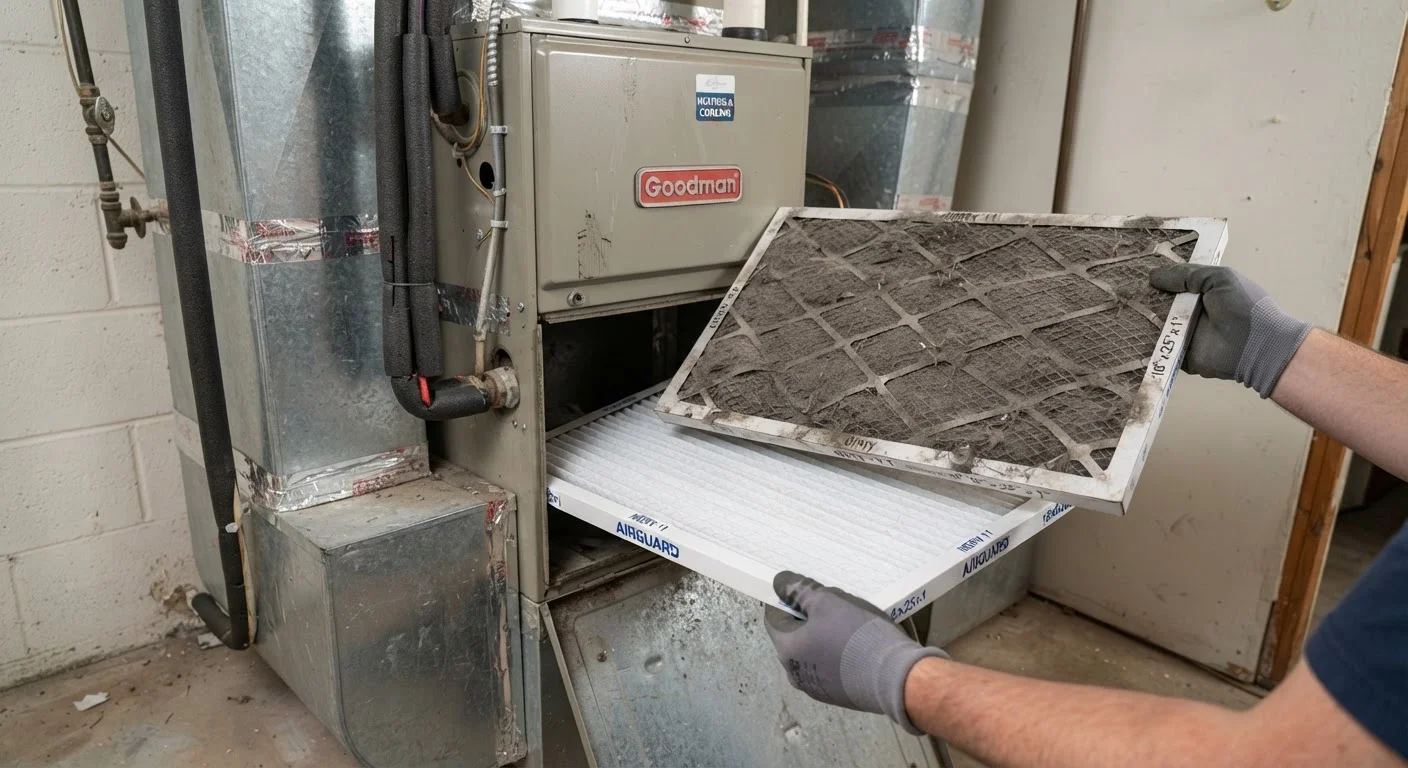
- Furnace Filter
- Sits inside the air handler or furnace cabinet and captures airborne particles - dust, pet dander, pollen - before they reach the blower and heat exchanger. A clogged filter restricts airflow, forcing the system to work harder and raising energy use.
- Supply Vents
- Wall, floor, or ceiling registers that push conditioned air into rooms. They can be adjusted to direct airflow but are not designed to be blocked or closed entirely.
- Return Vents
- Larger grilles - often in hallways or central areas - that draw room air back to the furnace for reconditioning. They have no louvers and should never be obstructed by furniture.
- Ductwork
- The network of metal or flexible channels that carries air between the furnace, vents, and living spaces. Leaky or dirty ducts can significantly reduce system efficiency.
For a broader picture of how HVAC fits into your overall home upkeep, see the complete homeowner's reference guide.
Furnace Filters: Frequency and Filter Type
Filter replacement is the one HVAC task nearly every homeowner can - and should - handle themselves. General guidance varies by filter type:
| Basic filter replacement frequency | Every 30-60 days (General HVAC industry guidance) |
| High-capacity media filter lifespan | Up to 12 months (Manufacturer guidelines vary; check your filter specs) |
| Recommended MERV range for most homes | MERV 8-13 (U.S. Department of Energy guidance) |
| Vent cover cleaning frequency | Twice per year minimum (General HVAC maintenance guidance) |
| Professional duct cleaning - typical need | Only when specific conditions exist (U.S. Environmental Protection Agency) |
| DIY safety level for filter replacement | Safe for most homeowners |
- 1-inch fiberglass or basic pleated filters: Replace every 30-60 days.
- 2- to 4-inch media filters: Replace every 3-6 months.
- 5-inch high-capacity filters: Replace every 9-12 months.
- Reusable electrostatic filters: Clean monthly; inspect for damage annually.
Households with pets, allergies, or heavy dust may need to replace filters more frequently than these baselines suggest. The filter's actual condition - not just the calendar - is the best indicator. Hold it up to light: if you can't see light through it, change it now.
Using a filter with a MERV rating higher than your system is designed for can actually restrict airflow and strain the blower motor. Check your furnace manual for the recommended MERV range before upgrading.
Vents and Registers: Cleaning on Your Own
Supply and return vent covers accumulate dust and can be safely cleaned as a DIY task. Here's a straightforward approach:
- Turn off the HVAC system before you start.
- Remove vent covers using a screwdriver.
- Wash covers in warm soapy water or wipe with a damp cloth.
- Vacuum several inches into the duct opening with a brush attachment.
- Reinstall covers once fully dry.
Doing this twice a year - typically when you change filters or follow your seasonal checklist - keeps registers from recirculating surface dust back into rooms. For a structured schedule, the seasonal home maintenance calendar is a useful reference.
Don't Close Off Unused Room Vents
It's a common misconception that closing vents in unused rooms saves energy. In most forced-air systems, doing so actually increases pressure in the ductwork, which can cause leaks and strain the blower motor. Keep all supply vents open unless an HVAC technician has specifically configured your system for zone-based airflow.
Duct Cleaning: When It's Warranted (and When It Isn't)
Professional duct cleaning is more involved than filter swaps or vent wipe-downs, and it isn't always necessary. The U.S. Environmental Protection Agency notes that duct cleaning has not been proven to prevent health problems and should be considered mainly in specific circumstances:
- Visible mold growth inside ducts or on HVAC components (requires professional remediation, not just cleaning)
- Evidence of rodent or insect infestation in the ductwork
- Ducts visibly clogged with heavy debris that restricts airflow
- After a major renovation that generated significant dust inside the home
If none of these conditions apply, routine filter changes and vent cleaning are generally sufficient for most homes. If you do hire a duct cleaning service, verify they follow industry standards - legitimate contractors use specialized vacuum equipment and will show you before-and-after access points, not just run a brush through a couple of registers.
25-40%
Energy wasted by a clogged or leaky HVAC system
According to the U.S. Department of Energy, duct leaks and airflow restrictions can account for significant energy losses in forced-air systems.
1-3 inches
Typical filter thickness range in residential furnaces
Filter thickness directly affects how often replacement is needed and what MERV ratings are compatible with your system.
Tasks involving ductwork that is inside walls, near gas connections, or attached to the furnace cabinet should be left to a licensed HVAC technician. For a clear breakdown of what's safe to DIY versus what requires a professional, see home maintenance tasks you can safely DIY.
If you're new to owning a home and these systems feel unfamiliar, the first-time homeowner's introduction to routine upkeep walks through core maintenance concepts in plain language.
The content on this site is for informational purposes only and is not a substitute for professional advice. Always consult a qualified professional for guidance specific to your situation.