

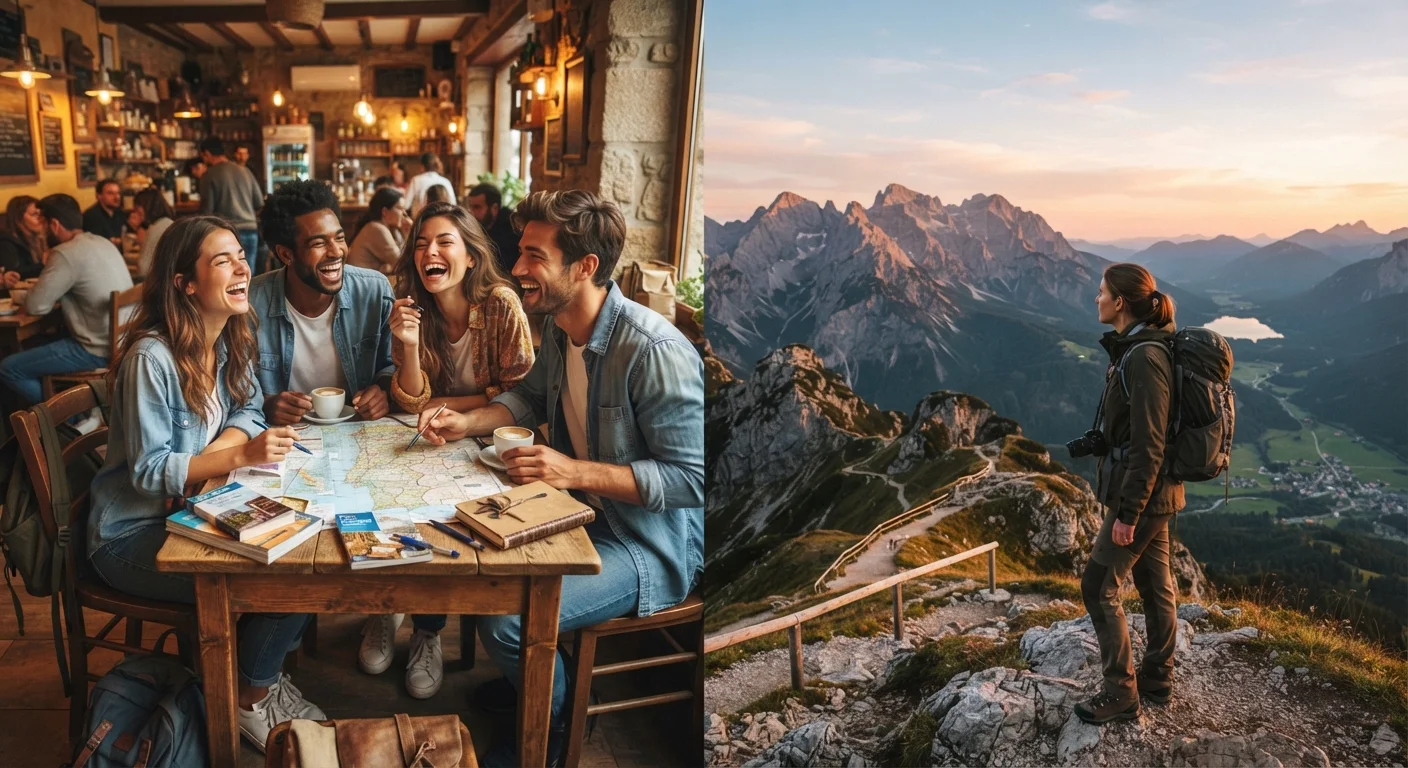
Option A
Group Travel
The shared-experience, cost-splitting approach.
Best for: Travelers who value companionship, shared costs, and built-in safety in numbers - especially on longer or international trips.
Option B
Solo Travel
The fully flexible, self-directed adventure.
Best for: Travelers who prize autonomy, spontaneity, and the personal growth that comes from navigating a new place entirely on their own terms.
What You're Actually Choosing Between
The group-vs-solo question isn't really about which style is objectively better. It's about which trade-offs you're more willing to live with on a given trip. Both approaches involve real costs and real rewards - and understanding those honestly is the most useful place to start.
Group travel means coordinating schedules, aligning budgets, and making collective decisions. In exchange, you get shared costs, built-in company, and - in many destinations - a meaningful safety advantage. Solo travel means full autonomy and the ability to pivot at will. The trade-off is that you carry every logistical decision yourself, often pay more per person, and have to be more deliberate about your own safety and social needs.
Worth noting: "group" doesn't have to mean ten people. Even two or three travelers share most of the dynamics discussed here. And "solo" doesn't mean lonely - many solo travelers are remarkably social on the road. For a grounded look at what the solo experience actually involves day-to-day, see what solo travel actually feels like.
The Cost Picture: Splitting vs. Surcharges
Money is where group travel has its clearest structural advantage. Vacation rentals, hotel rooms with multiple beds, rental cars, and even restaurant meals often cost less per person when divided among a group. A beach house split four ways can cost less than two nights in a mid-range hotel for a single traveler.
Solo travelers, on the other hand, frequently encounter the single supplement - an extra charge applied by tour operators and some hotels to solo occupants. This can add 10% to 100% to the base price of a room or package. That said, solo travelers also avoid the financial friction that groups can generate: disagreements over restaurant choices, one person who always wants the upgrade, or the awkward math of splitting unequal tabs.
| Criterion | Group Travel | Solo Travel |
|---|---|---|
| Accommodation cost | Lower per person (split) | Higher (single supplements) |
| Scheduling flexibility | Requires group consensus | Fully self-directed |
| Built-in companionship | Always present | Must be actively sought |
| Safety in numbers | Structural advantage | Requires more preparation |
| Decision-making speed | Slower; needs alignment | Instant; no negotiation |
| Personal growth potential | Moderate | High - full self-reliance |
| Risk of interpersonal friction | Real; varies by group | None |
Managing shared group expenses is its own skill. Tracking who paid for what across a week-long trip can get messy fast. Apps designed for splitting costs can help, though even then, someone usually ends up doing most of the accounting. If you want to compare how different tracking approaches work, tracking spending by hand vs. using an app offers a useful framework.
Flexibility and Decision-Making
Solo travel's greatest advantage isn't safety or savings - it's uncompromised flexibility. You decide when to wake up, what to eat, how long to stay at a site, and whether to scrap the plan entirely and spend the afternoon on a park bench. That kind of freedom is genuinely hard to replicate in a group.
Group travel involves negotiation by definition. Even among close friends, you'll encounter different energy levels, appetite preferences, and risk tolerances. One person wants the off-the-beaten-path hiking trail; another wants air conditioning and a pool. Neither preference is wrong - but reconciling them takes time and goodwill.
~25%
Solo travelers who are first-timers
Travel industry surveys have consistently found that a significant share of solo travelers - often estimated around a quarter - are doing it for the first time, suggesting curiosity rather than experience is a common motivator.
50-100%
Typical single supplement range
Tour operators commonly add a single supplement of 50% to 100% of the per-person base price when a traveler occupies a room alone, according to widely cited travel industry guidance.
The more people in the group, the more coordination overhead you should expect. Multi-city trips amplify this considerably - logistics that a solo traveler resolves in minutes can take a group hours to align. For practical ways to manage that complexity, approaches that make multi-city trips manageable is worth a read before you start booking.
Safety, Social Dynamics, and What People Don't Say Out Loud
Safety is a real and legitimate consideration - not a reason to avoid solo travel, but a factor worth thinking through honestly. Traveling with others generally means someone always knows where you are, there's help if something goes wrong, and you present less of an opportunistic target in unfamiliar areas. For certain destinations - particularly those with higher rates of petty crime or limited English-language infrastructure - the practical safety margin of group travel is meaningful.
Solo travelers can and do navigate the world safely every day, but it requires more deliberate preparation: sharing itineraries with someone at home, staying in well-reviewed accommodations, and being more attuned to local norms and surroundings. These habits are worth developing regardless of how you travel. For entry requirements, local laws, and destination-specific safety advisories, always verify current conditions through official government sources before departure - conditions change and no article can substitute for up-to-date official guidance.
The social dimension is subtler but equally real. Group travel provides constant companionship - which is wonderful until it's exhausting. Solo travel can feel deeply freeing or genuinely lonely depending on the destination, the traveler's personality, and the day. Many solo travelers actively build social experiences into their trips: group tours for a day, hostel common areas, or organized local activities. The travel tips hub has practical resources for both styles of traveler.
If your trip involves family, the calculus shifts further - children change pacing, documentation requirements, and contingency planning in ways that deserve their own consideration. Traveling with kids covers what shifts when younger travelers are part of the picture.
Neither Style Is All-or-Nothing
Many experienced travelers mix both approaches across a single year - or even a single trip. You might fly to a destination solo, then join a small group tour for a few days before peeling off again. Thinking of group and solo travel as a spectrum rather than a binary choice opens up more options and often leads to a more satisfying experience overall.
The content on this site is for informational purposes only and is not a substitute for professional advice. Always consult a qualified professional for guidance specific to your situation.