

Our Verdict
Automated savings transfers are one of the most reliable tools everyday consumers have for building financial security over time. The mechanics are straightforward, and the psychological benefit of removing willpower from the equation is real. The main risks - overdrafts and set-it-and-forget-it complacency - are manageable with a little upfront planning and periodic check-ins.
Automation works especially well for people with a steady, predictable income who struggle to save manually and want a low-effort way to build a cushion over time.
How Automated Savings Actually Works
Automated savings simply means instructing your bank or credit union to move a set dollar amount from your checking account to a savings account on a recurring schedule - weekly, biweekly, or monthly. Most banks let you set this up in minutes through online banking or a mobile app, with no fee to do so.
The core idea draws from the pay-yourself-first principle: treat savings like a bill you owe yourself, due every payday. When money moves automatically before you have a chance to spend it, you adapt your spending to whatever is left - rather than trying to save whatever happens to remain at month's end. For a deeper look at savings approaches that use this same logic, see well-established savings strategies that hold up over time.
If you're starting from scratch, building a savings habit from zero covers the mindset shifts worth making before you flip the automation switch.
The Real Advantages of Setting It and Scheduling It
The benefits of automating your savings go beyond simple convenience.
Removes willpower from the equation
When saving happens automatically, you never have to decide whether to transfer money - it's already done. This eliminates one of the most common reasons people don't save: forgetting or choosing not to.
Builds consistency without extra effort
Regular, small transfers add up steadily over time. Even a $25-per-week automated transfer produces $1,300 in a year without any manual action after setup.
Reduces lifestyle inflation risk
When savings move out immediately after a paycheck arrives, you naturally adjust spending to what's left. This makes it harder to unconsciously spend income increases rather than save them.
Easy to start and adjust
Most banks allow you to set up, pause, or change automated transfers through a mobile app in a few minutes, with no fees or penalties for adjustments.
Pairs well with specific savings goals
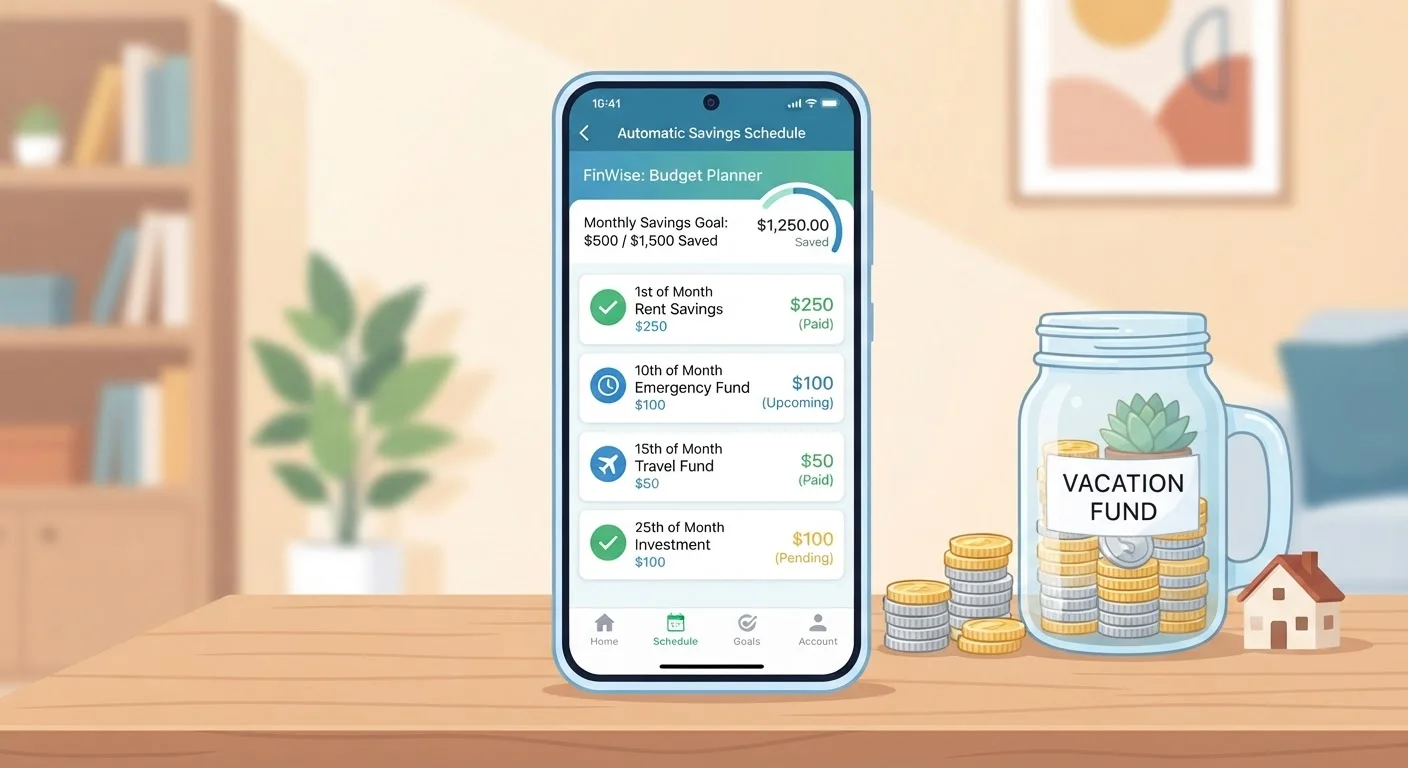
You can direct separate automated transfers to different accounts - one for emergencies, one for a vacation, one for home repairs - keeping each goal funded without manual juggling.
One often-overlooked advantage: automation pairs well with any savings account type you're using. Whether you're directing funds to an emergency fund, a high-yield savings account, or a CD, the transfer mechanism is the same. If you're unsure which account type fits your goal, common savings vehicles explained lays out the differences in plain language.
The Risks Worth Knowing Before You Automate
Automation is a tool, not a guarantee. A few common pitfalls can turn a good habit into an expensive one.
Mistimed transfers can trigger overdraft fees
If a transfer goes through before your paycheck clears, your checking account balance can drop below zero. Overdraft fees typically range from $25 to $35 per occurrence, quickly negating any savings progress.
Can create a false sense of financial security
Seeing money move automatically may lead some people to stop paying attention to their overall budget. Automation handles one task - it doesn't manage spending, debt, or unexpected expenses.
Fixed amounts don't adapt to variable income
Freelancers, gig workers, or anyone with irregular paychecks may find that a fixed automatic transfer works fine some months and causes a shortfall in others.
Easy to forget and never increase
The same convenience that makes automation powerful can also mean you set a small amount and never revisit it, leaving potential savings on the table as your income grows.
Requires a baseline checking account buffer
Automation only works smoothly if your checking account maintains enough of a balance to cover both the transfer and your regular expenses. Without that buffer, the system can create more problems than it solves.
Variable Income? Adjust the Approach
If your income fluctuates month to month - common with freelance, contract, or tip-based work - a fixed automated transfer may not fit. One practical alternative: transfer a set percentage of each deposit rather than a fixed dollar amount. Some banks support percentage-based rules; others require a manual transfer after each deposit. Either way, saving something consistently still beats saving nothing. Review your transfer amounts whenever your income pattern shifts significantly.
It also helps to understand the difference between an emergency fund and a general savings account - they serve different purposes and may warrant separate automated transfers. See emergency fund vs. savings account for a clear breakdown.
Setting Up Your Automation the Smart Way
A few practical steps make automated savings work with your budget rather than against it.
- Align transfer dates with your paycheck. Schedule the transfer for one to two business days after your direct deposit lands. This simple timing adjustment eliminates most overdraft risk.
- Start smaller than you think you need to. A transfer you barely notice is far more sustainable than an ambitious one you cancel after two months. You can increase the amount once the habit feels natural.
- Use a separate account. Keeping savings physically separate from your checking account reduces the temptation to dip into it. An account at a different institution adds a small layer of friction that many people find helpful.
- Review it quarterly. Income changes, bills change, and goals change. Set a calendar reminder every three months to check that the amount and destination still make sense.
Automated saving works best as part of a broader budget. If you haven't mapped out your monthly cash flow yet, the personal budgeting complete guide is a practical place to start. And if spending habits are quietly outpacing your saving, shopping habits that slowly erode a budget is worth a read alongside this one.
73%
Americans living paycheck to paycheck at some point
Various surveys over recent years have consistently found that a large majority of U.S. adults report difficulty maintaining savings, underscoring why removing friction from the saving process matters.
$1,300+
Saved annually from just $25 per week
A consistent $25 weekly automated transfer, left untouched, accumulates to over $1,300 in 12 months - before any interest - illustrating how small amounts compound into meaningful cushions.
This article is for general informational purposes only and is not personalized financial advice. Consult a licensed financial professional regarding decisions specific to your situation.
The content on this site is for informational purposes only and is not a substitute for professional advice. Always consult a qualified professional for guidance specific to your situation.