

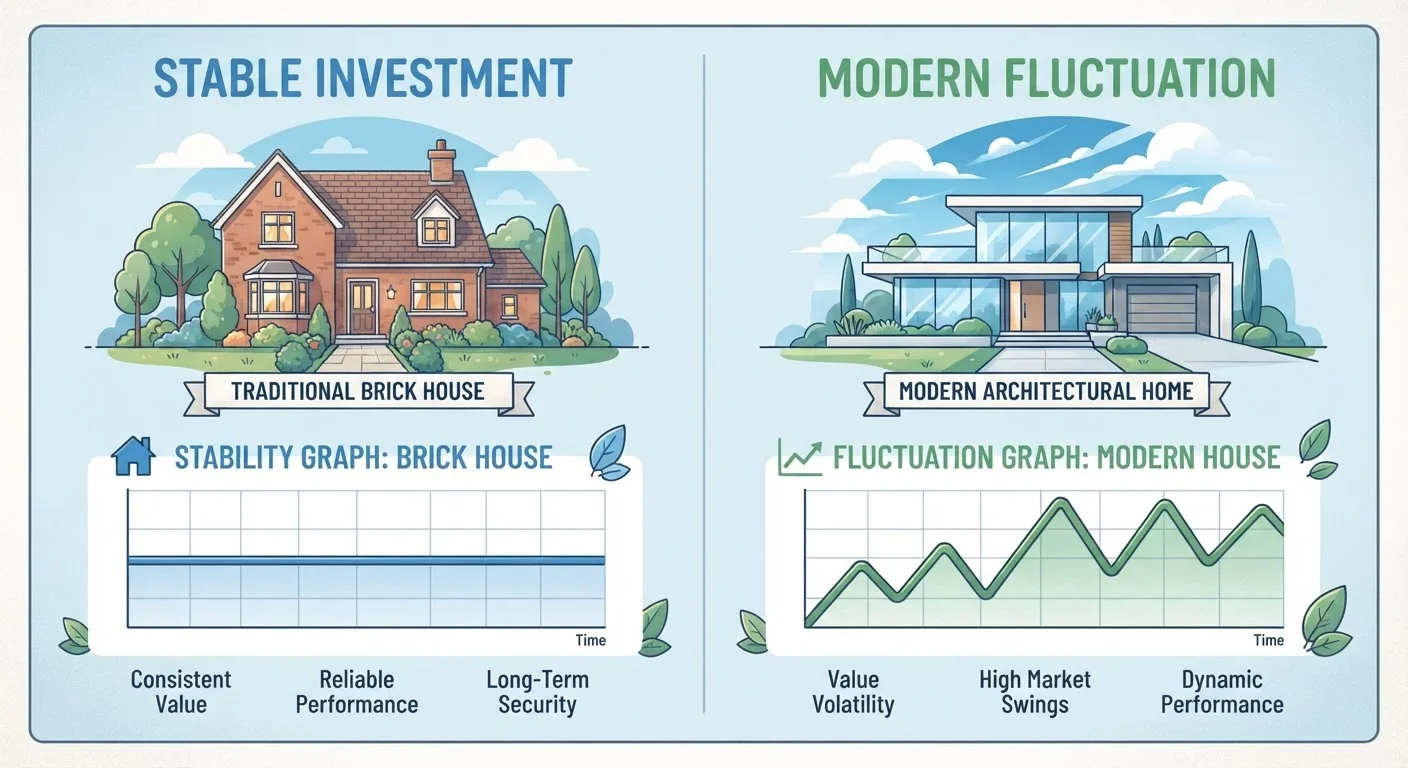
Option A
Fixed-Rate Mortgage
The predictable, set-it-and-forget-it loan.
Best for: Buyers who plan to stay in a home long-term and want a consistent monthly payment.
Option B
Adjustable-Rate Mortgage (ARM)
The flexible loan with a rate that moves over time.
Best for: Buyers who expect to sell or refinance within a few years and want a lower starting rate.
How Each Mortgage Type Works
A fixed-rate mortgage does exactly what its name suggests: the interest rate is set at closing and never changes. Whether you borrow for 15 years or 30 years, your principal-and-interest payment remains the same every month. Property taxes and homeowner's insurance - which are often bundled into your monthly escrow payment - can change, but the loan portion stays constant.
An adjustable-rate mortgage (ARM) has two distinct phases. First comes the fixed period - commonly 5, 7, or 10 years - during which your rate is locked and behaves just like a fixed-rate loan. After that, the rate adjusts at regular intervals (usually once a year) based on a benchmark market index, plus a set margin. A "5/1 ARM" means the rate is fixed for five years, then adjusts once per year afterward.
To understand why these choices matter so much, it helps to see how mortgage rates influence the broader housing market - even a small rate difference compounds significantly over a 30-year loan.
| Criterion | Fixed-Rate Mortgage | Adjustable-Rate Mortgage (ARM) |
|---|---|---|
| Interest rate over time | Never changes | Fixed initially, then adjusts periodically |
| Monthly payment stability | Completely predictable | Can rise or fall after fixed period |
| Typical starting rate | Slightly higher | Often lower than fixed |
| Best time horizon | Long-term (10+ years) | Short-to-medium term (under 7-10 years) |
| Rate change protections | Not needed - rate never moves | Periodic and lifetime caps apply |
| Risk level | Low - no payment surprise | Moderate - future payment uncertain |
| Common loan terms | 15-year or 30-year | 5/1, 7/1, or 10/1 ARM |
Rate Caps: The Safety Net on ARMs
One of the biggest fears about ARMs is that payments could spiral upward. Federal regulation and standard loan agreements address this through rate caps, which limit how much the interest rate can move at any one time or over the life of the loan.
Most ARMs come with a three-cap structure, often written as something like 2/2/5:
- Initial adjustment cap: The maximum the rate can rise at the first adjustment (commonly 2%).
- Periodic cap: The maximum it can rise at each subsequent adjustment (also commonly 2%).
- Lifetime cap: The maximum it can rise above the original starting rate over the entire loan (commonly 5%).
This means if you started at 5%, the rate could never exceed 10% under a 5-percentage-point lifetime cap - regardless of what the index does. Caps do not protect against all risk, but they do define the worst-case scenario, which helps with planning.
What Index Does an ARM Follow?
Most modern ARMs in the U.S. are tied to the Secured Overnight Financing Rate (SOFR), which replaced the older LIBOR index. When this benchmark rises, ARM rates typically rise at their next adjustment; when it falls, rates can decrease. Your loan documents will specify which index applies, the margin added on top, and exactly when and how adjustments occur. Always review these details carefully before signing.
Your credit score also plays a role in what rate you'll be offered on either loan type. See what your credit score does to your mortgage options for a breakdown of how lenders evaluate your application.
Weighing Cost, Predictability, and Your Plans
The right mortgage type depends heavily on how long you intend to stay, how stable your income is, and your comfort with financial uncertainty. Neither option is universally better.
30 years
Most common fixed-rate mortgage term in the U.S.
According to Freddie Mac, the 30-year fixed-rate mortgage has historically been the most widely used home loan product among American borrowers.
~0.5-1%
Typical initial rate advantage of an ARM over a 30-year fixed
The Consumer Financial Protection Bureau notes that ARMs generally start with a lower rate than comparable fixed-rate loans, though the margin varies with market conditions.
Fixed-rate mortgages tend to carry a slightly higher initial rate than ARMs because lenders are absorbing the risk of rate changes for the full term. You pay a premium for certainty - but that certainty has real value when you're budgeting years ahead. For everyday buyers who want a housing cost that behaves like a fixed expense in their monthly budget, this is often the most straightforward path.
ARMs make the most financial sense when the initial rate savings are significant and you have a clear reason to believe you won't carry the loan into the adjustment period - a planned relocation, a likely sale, or confidence you'll refinance. They require more active attention and carry more uncertainty.
If you're still deciding whether to buy at all, a broader look at renting vs. buying a home can help frame the larger decision before drilling into loan types.
This article is for general informational purposes only and does not constitute financial, legal, or mortgage advice. Mortgage terms, rates, and eligibility vary by lender and individual circumstances. Consult a licensed mortgage professional or financial adviser before making borrowing decisions.
The content on this site is for informational purposes only and is not a substitute for professional advice. Always consult a qualified professional for guidance specific to your situation.