

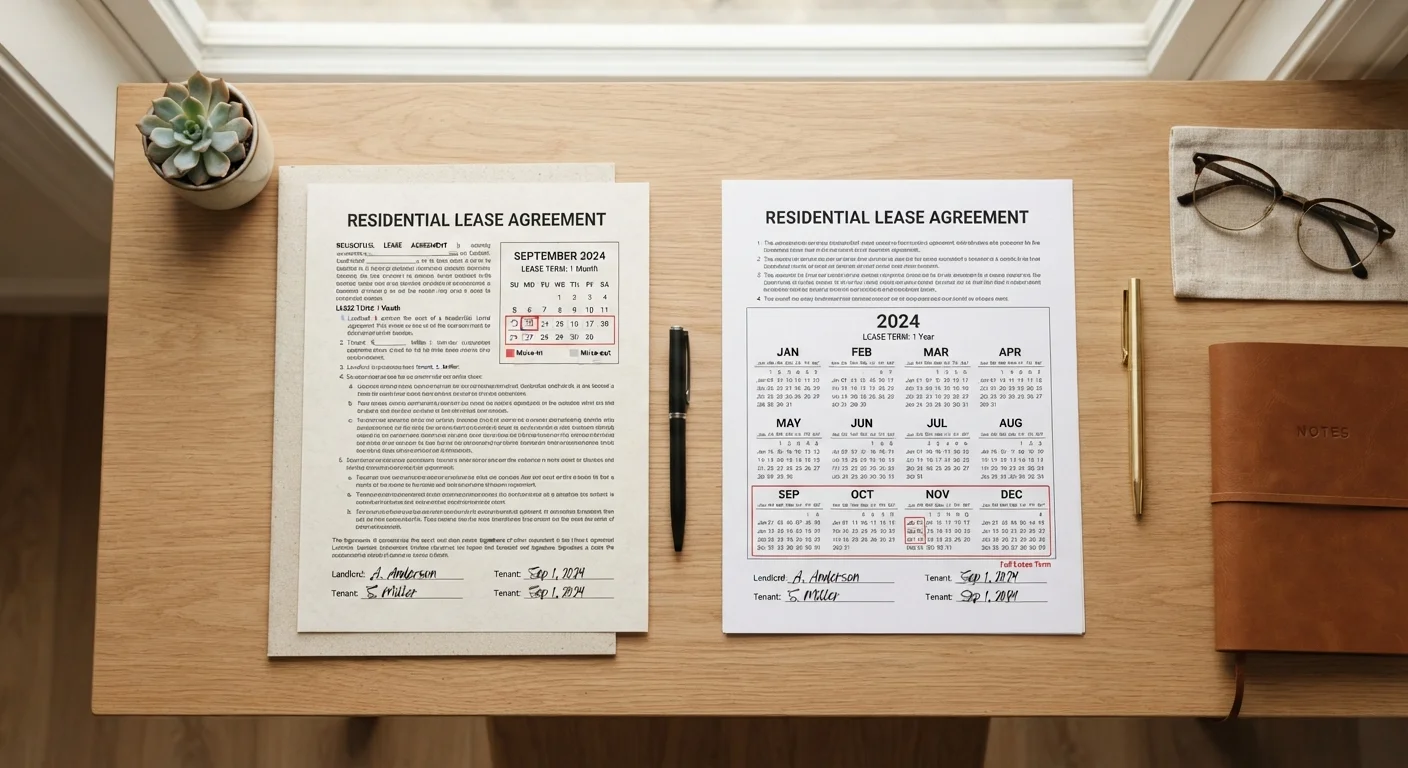
Option A
Month-to-Month Lease
The flexible, rolling arrangement for renters who need room to move.
Best for: Renters with uncertain timelines, job relocations, or transitional housing needs who want the ability to leave with short notice.
Option B
Fixed-Term Lease
The stable, structured commitment for renters who want predictability.
Best for: Renters who plan to stay in one place for at least a year and want locked-in rent and stronger housing security.
What Each Lease Type Actually Means
A fixed-term lease is a rental agreement that runs for a specific period - most commonly 12 months, though 6-month and 18-month terms exist. During that time, both you and your landlord are bound by the agreed rent and conditions. Neither party can change the core terms without mutual consent until the lease expires.
A month-to-month lease (sometimes called a tenancy at will or periodic tenancy) renews automatically every 30 days under the same terms. It continues indefinitely until either the tenant or landlord provides proper written notice to end it. Some month-to-month arrangements start that way from day one; others begin after a fixed-term lease expires and the tenant stays on without signing a new agreement.
If you want a clear breakdown of the terminology you'll encounter in either type of lease, see our plain-language rental glossary for definitions of holdover clauses, prorated rent, and more.
| Criterion | Month-to-Month Lease | Fixed-Term Lease |
|---|---|---|
| Typical duration | Renews every 30 days | Set period (usually 12 months) |
| Rent stability | Can change with proper notice | Locked in for the lease term |
| Tenant flexibility | High - exit with 30 days' notice | Low - early exit may trigger penalties |
| Typical monthly cost | Often higher than fixed-term | Generally lower per month |
| Landlord's ability to end tenancy | Can give notice anytime (with required notice) | Generally cannot end without cause before term |
| Auto-renewal risk | Ongoing by nature | Possible if auto-renewal clause is included |
| Best market condition | When you expect to move soon | When you want stability in a rising-rent market |
Flexibility vs. Security: The Central Trade-Off
Month-to-month leases offer genuine flexibility - the ability to move out, often with just 30 days' written notice, without facing early termination penalties. That matters if your job, family situation, or finances could shift. But that flexibility cuts both ways: landlords on month-to-month arrangements can also raise rent or end the tenancy with the same short notice, as long as local law permits and any required notice period is followed.
Fixed-term leases provide something month-to-month agreements rarely can: rent certainty. Your landlord generally cannot raise your rent mid-lease unless the agreement explicitly allows it. You also have stronger grounds to stay in the unit - a landlord typically cannot ask you to leave before your term ends without cause.
The downside of a fixed-term lease is rigidity. If you need to leave before the term is up, you may owe an early termination fee, be held responsible for rent until a new tenant is found, or lose your security deposit. Always read the early termination clause carefully before signing - our article on lease clauses that catch renters off guard covers what to look for.
30 days
Typical minimum notice to vacate (month-to-month)
Most U.S. states set the standard notice period at 30 days for month-to-month tenancies, though some require 60 days for longer-term occupants.
12 months
Most common fixed-term lease length in the U.S.
According to the U.S. Census Bureau's American Housing Survey, one-year leases are by far the most widely used fixed-term arrangement among American renters.
~44%
U.S. households that are renters
The U.S. Census Bureau estimates that roughly 44% of American households rent their homes, making lease literacy an essential financial skill for tens of millions of people.
Cost Differences Renters Often Miss
Month-to-month leases are almost always priced higher than fixed-term equivalents for the same unit. Landlords price in the uncertainty - they may need to find a new tenant on short notice, and that risk carries a premium. The gap varies widely by market and landlord, but it's common to see month-to-month rents run noticeably higher per month than the equivalent annual-lease rate.
Fixed-term leases, by contrast, tend to offer the lowest per-month rate because you're committing to predictable occupancy. Over a full year, even a modest monthly difference adds up significantly.
There are also indirect costs to consider. Breaking a fixed-term lease early can be expensive. And if a landlord on a month-to-month arrangement raises rent sharply, you may face relocation costs you didn't budget for. For a broader view of how lease type intersects with overall housing costs, our piece on renting vs. owning in a volatile market is worth reading alongside this one.
Local Laws Can Change These Rules
Rent control ordinances, just-cause eviction requirements, and mandatory notice periods vary significantly by state and city. Some jurisdictions give tenants considerably more protection than the defaults described here. Before signing any lease, check your state's landlord-tenant statute or consult a local tenant's rights organization to understand what rules apply specifically to you. This article provides general educational information, not legal advice.
Notice Rules and How They Work in Practice
Notice requirements are one of the most practical differences between lease types - and one renters most often get wrong.
Under a month-to-month lease, the standard notice period in most U.S. states is 30 days, though some states require 60 days, and local ordinances may add protections. Notice rules apply to both tenant and landlord. If you want to leave, you typically give 30 days' written notice. If your landlord wants to end the tenancy or raise the rent, they must do the same.
Under a fixed-term lease, formal notice to vacate often isn't required at expiration - the lease simply ends. But many leases include an auto-renewal clause, which means your tenancy automatically converts to month-to-month (or renews for another term) if you don't provide written notice within a specific window before the end date. Missing that window can trap you in another term or change your notice obligations. For more on this, see our guide to what a lease agreement actually says.
Always check your state's landlord-tenant law for the specific notice periods that apply in your jurisdiction, as they vary and local rules can override standard defaults.
The content on this site is for informational purposes only and is not a substitute for professional advice. Always consult a qualified professional for guidance specific to your situation.