

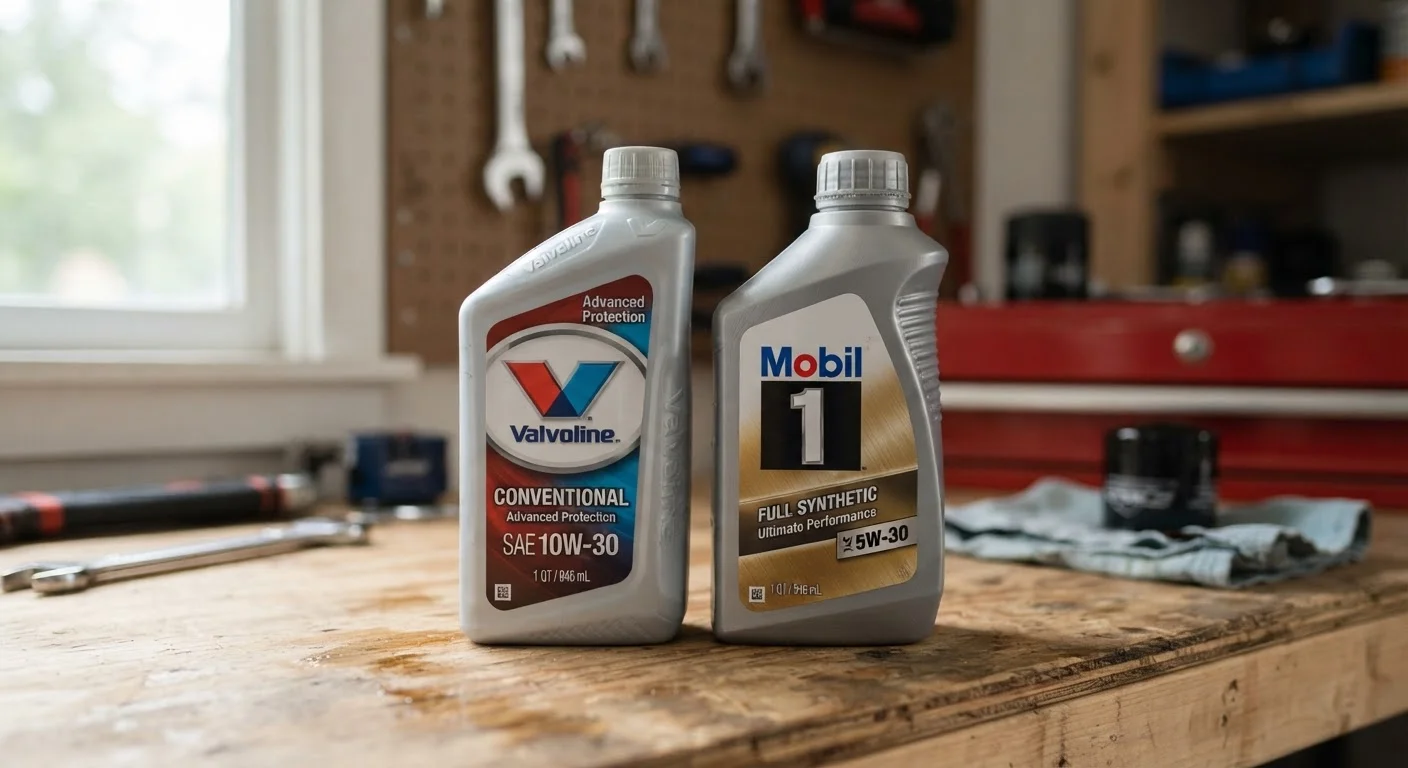
Option A
Conventional Motor Oil
The time-tested, widely available standard.
Best for: Older vehicles, low-mileage drivers, or engines with simple specifications that don't call for full synthetic.
Option B
Synthetic Motor Oil
The engineered, higher-performance option.
Best for: Modern engines, turbocharged vehicles, extreme climates, or drivers who go longer between oil changes.
What Sets These Two Oils Apart
Both conventional and synthetic motor oil do the same fundamental job: lubricate your engine's moving parts, reduce friction, carry heat away, and help keep internal components clean. The difference is in how they're made and how they perform under stress.
Conventional oil is refined directly from crude petroleum. It contains naturally occurring molecules of varying sizes and shapes, which means its performance can vary more with temperature changes. It works well for most standard engines under normal driving conditions.
Synthetic oil is engineered in a laboratory. The molecules are uniform in size and designed to perform consistently across a wider range of temperatures - staying fluid in bitter cold and resisting breakdown under high heat. Some synthetics start with a conventional base oil that's been heavily refined; others are built entirely from chemical compounds.
There's also a middle ground: synthetic blend oil, which mixes conventional and full synthetic base stocks. It offers some of the performance benefits of synthetic at a lower cost than full synthetic.
| Criterion | Conventional Oil | Synthetic Oil |
|---|---|---|
| Base material | Refined crude petroleum | Engineered chemical compounds |
| Typical cost per change | Lower upfront cost | Higher upfront cost |
| Typical change interval | 3,000-5,000 miles (varies) | 7,500-10,000+ miles (varies) |
| Cold weather performance | Thickens more in extreme cold | Flows better at low temperatures |
| Heat resistance | Breaks down faster under high heat | More stable at high temperatures |
| Turbocharged engine suitability | Generally not recommended | Required or strongly recommended |
| Best suited for | Older or simpler engines, mild climates | Modern, high-performance, or stressed engines |
Cost, Change Intervals, and What Your Manual Says
A conventional oil change typically runs less per service than a full synthetic change. However, synthetic oil generally allows for longer intervals between changes - often 7,500 to 10,000 miles or more, depending on the oil and your vehicle, compared to the 3,000 to 5,000 miles often cited for conventional. Over time, that gap in per-service cost can narrow considerably.
~2x
Typical cost difference per oil change
A full synthetic oil change commonly costs roughly twice as much per service as a conventional change, though actual prices vary widely by region and shop.
7,500-10,000 mi
Common synthetic change interval
Many vehicle manufacturers specify extended oil change intervals for full synthetic oil; always confirm with your owner's manual for your specific engine.
~50%
Share of new U.S. vehicles requiring synthetic
Industry estimates suggest a majority of new passenger vehicles sold in the U.S. now call for full or synthetic-blend oil based on manufacturer specifications.
That said, the single most important source for this decision is your vehicle's owner's manual. It specifies the oil viscosity grade (such as 5W-30) and whether synthetic is required, recommended, or optional for your engine. Using a lower grade than required can void a powertrain warranty or cause real engine wear. Using a higher grade than needed rarely hurts, but it won't necessarily help either.
The old "every 3,000 miles" rule is largely outdated for modern vehicles. If you're still following it regardless of oil type or manufacturer guidance, our piece on common car maintenance myths breaks down why that rule persists - and when it doesn't apply.
When Synthetic Is Essentially Required
For some vehicles, using conventional oil isn't just a performance downgrade - it can cause real problems. Here's where synthetic is generally necessary:
- Turbocharged engines: The turbocharger spins at extremely high speeds and generates intense heat. Conventional oil can break down faster in these conditions, leaving deposits that damage the turbo over time.
- High-performance engines: Engines with tight tolerances and higher operating temperatures are engineered around synthetic's stable viscosity.
- Very cold climates: In temperatures well below freezing, conventional oil thickens and flows slowly at startup - exactly when your engine needs immediate lubrication. Synthetic flows more readily in the cold.
- Extended drain intervals: If your vehicle uses an oil life monitoring system that stretches change intervals beyond 5,000 miles, synthetic is typically required to maintain protection that long.
Skipping proper oil maintenance - regardless of type - carries serious engine risks. Our article on what happens when you skip an oil change explains exactly what's at stake inside your engine when oil degrades.
Can You Switch Between Oil Types?
Switching from conventional to synthetic - or back - is generally safe for most engines. Modern synthetic and conventional oils are compatible and can be mixed without causing damage, though mixing is not a recommended long-term approach. If you've been using conventional and want to switch to synthetic, a standard oil change is all it takes. Always use the viscosity grade your owner's manual specifies, regardless of which type you choose.
If you're handling your own oil changes, know where the line is between simple DIY and work that warrants a professional. Our guide on DIY car maintenance vs. taking it to a mechanic can help you decide.
The content on this site is for informational purposes only and is not a substitute for professional advice. Always consult a qualified professional for guidance specific to your situation.