

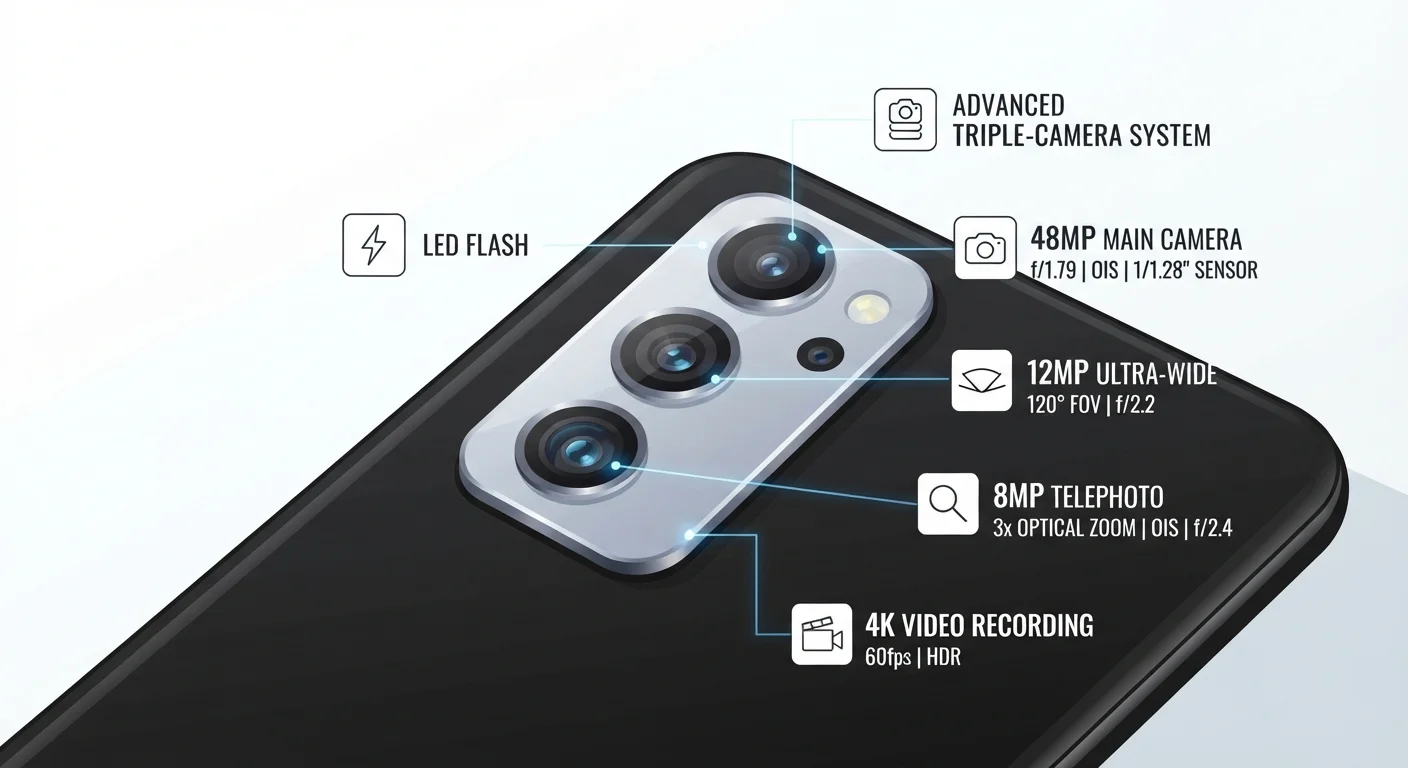
Why Camera Specs Confuse Shoppers
Phone camera spec sheets are designed to impress, not to educate. Numbers like '200MP' or '100x Space Zoom' are engineered to stand out in a crowded market - not to describe how a photo will actually look in your living room or at a birthday party. Understanding which specs map to real photographic outcomes, and which are mostly marketing shorthand, is the first step toward making a smarter choice.
For a broader grounding in how phone specs translate to real-world performance, see our guide to smartphone specs decoded. This article focuses specifically on the camera claims that matter - and the ones that don't.
Myth
More megapixels always means sharper, better-looking photos.
Fact
Sensor size and pixel quality matter far more than raw megapixel count for most everyday shooting.
A megapixel (MP) measures how many millions of pixels the camera captures per image. A 108MP sensor sounds impressive, but if those pixels are crammed onto a tiny sensor, each individual pixel captures very little light. The result is noise and washed-out color, especially indoors or at night.
Larger sensors - even with fewer megapixels - gather more light per pixel, producing cleaner, more detailed images. Sensor size is rarely listed prominently in marketing but is one of the most meaningful specs you can look up.
Myth
A lower f-number (aperture) always produces blurry, unusable backgrounds.
Fact
A lower f-number means a wider aperture, which lets in more light - an advantage in dim conditions, not a flaw.
Aperture is expressed as an f-number: f/1.8, f/2.0, f/2.4, and so on. Counter-intuitively, a lower f-number means a wider opening. A wider aperture captures more light, which improves low-light performance significantly.
The background blur (called 'bokeh') that a wide aperture can create is often a desired artistic effect in portrait photography. On phone cameras, however, much of this blur is simulated through software anyway - so the aperture's primary practical benefit for most users is simply better performance in darker environments.
Myth
More camera lenses on the back means the phone takes better photos.
Fact
The quality and size of each lens matters much more than how many lenses are present.
Manufacturers sometimes add lenses to a spec sheet that serve very limited real-world purposes - such as a 2MP depth sensor that contributes minimally beyond what software already handles, or a low-resolution macro lens with a fixed focal length that produces soft images.
A phone with two well-engineered lenses - a strong main camera and a capable ultrawide - will typically outperform a phone with four mediocre lenses. Count the lenses that have meaningful apertures and sensor sizes, not just the total number.
Myth
Higher video resolution (like 8K) always gives you the best video quality.
Fact
Stabilization, dynamic range, and frame rate options are usually more valuable for everyday video than maximum resolution.
Recording at 8K or even 4K at high frame rates generates enormous file sizes and demands significant processing power. For most everyday use - social media clips, family moments, travel footage - well-implemented optical image stabilization (OIS) and reliable autofocus will produce noticeably better results than raw resolution alone.
If you plan to shoot video frequently, look at whether the camera supports log footage, how well it handles mixed lighting, and whether stabilization is hardware-based or software-only.
Myth
Optical zoom and digital zoom are the same thing with different names.
Fact
Optical zoom uses physical lens movement to magnify; digital zoom simply crops and enlarges the image, reducing quality.
Optical zoom on a smartphone typically means a secondary telephoto lens with a longer focal length - it captures a genuinely magnified image without discarding pixel data. Digital zoom, by contrast, takes the existing image and enlarges a portion of it, which softens detail the same way enlarging a small JPEG does.
A '3x optical zoom' is a substantively useful capability. '10x digital zoom' on a phone without a telephoto lens is largely a marketing figure. Hybrid zoom blends both, so the quality sits between the two.
The Specs That Actually Shape Your Photos
Once you set aside the headline numbers, a handful of specs consistently correlate with image quality in practice.
Marketing Numbers vs. Real-World Results
Phone makers routinely lead with megapixel counts and camera counts because big numbers are easy to advertise. Before assuming a higher number means better photos, check whether the spec translates to actual image quality improvements - or whether it's primarily a marketing figure. Independent camera benchmarks and sample image comparisons are far more reliable indicators.
Sensor size is the single most meaningful hardware spec for image quality. A physically larger sensor gathers more light, which reduces noise and preserves color accuracy - particularly in dim conditions. Look for this spec listed in fractions of an inch (e.g., 1/1.56") in detailed product pages rather than on box copy.
Aperture (the f-number) directly affects how much light the lens admits. A wider aperture (lower f-number) is particularly helpful indoors and at night. Combined with a large sensor, a wide aperture is a strong predictor of low-light performance.
Optical image stabilization (OIS) uses physical hardware to counteract hand movement during a shot. This reduces blur in handheld photos and produces smoother video - a spec worth verifying if you shoot frequently in motion or in lower light.
Digital Zoom Can Mislead You
A spec sheet listing '10x zoom' may refer to digital zoom rather than optical zoom. Digital zoom degrades image quality because it enlarges and crops pixels rather than using actual lens optics. Always check whether zoom specs are optical, hybrid, or digital before using zoom range as a comparison point between devices.
Computational photography - the software that processes every image after capture - is increasingly decisive. Two phones with identical hardware specs can produce noticeably different results based on their image processing algorithms. This is why sample photos and independent camera tests are often more informative than spec comparisons alone. Our article on why similar specs can feel different explores this dynamic further.
1/1.3"
Sensor size on leading flagship cameras
Top-tier flagship phones use sensors around 1/1.3 inches, substantially larger than the 1/2.5-inch sensors common on mid-range and budget devices, resulting in measurably better low-light performance.
f/1.5-f/1.8
Aperture range on strong main cameras
Most well-regarded smartphone main cameras fall within the f/1.5 to f/1.8 aperture range, a range widely associated with capable low-light capture in independent camera evaluations.
~85%
Photo processing handled by software
Industry observers broadly estimate that the majority of what makes a modern phone photo look good - noise reduction, HDR, sharpening - is determined by computational photography software rather than hardware alone.
For context on specs that sound impressive but deliver limited practical value, our piece on smartphone features that rarely get used covers this pattern across the phone as a whole.
The content on this site is for informational purposes only and is not a substitute for professional advice. Always consult a qualified professional for guidance specific to your situation.