

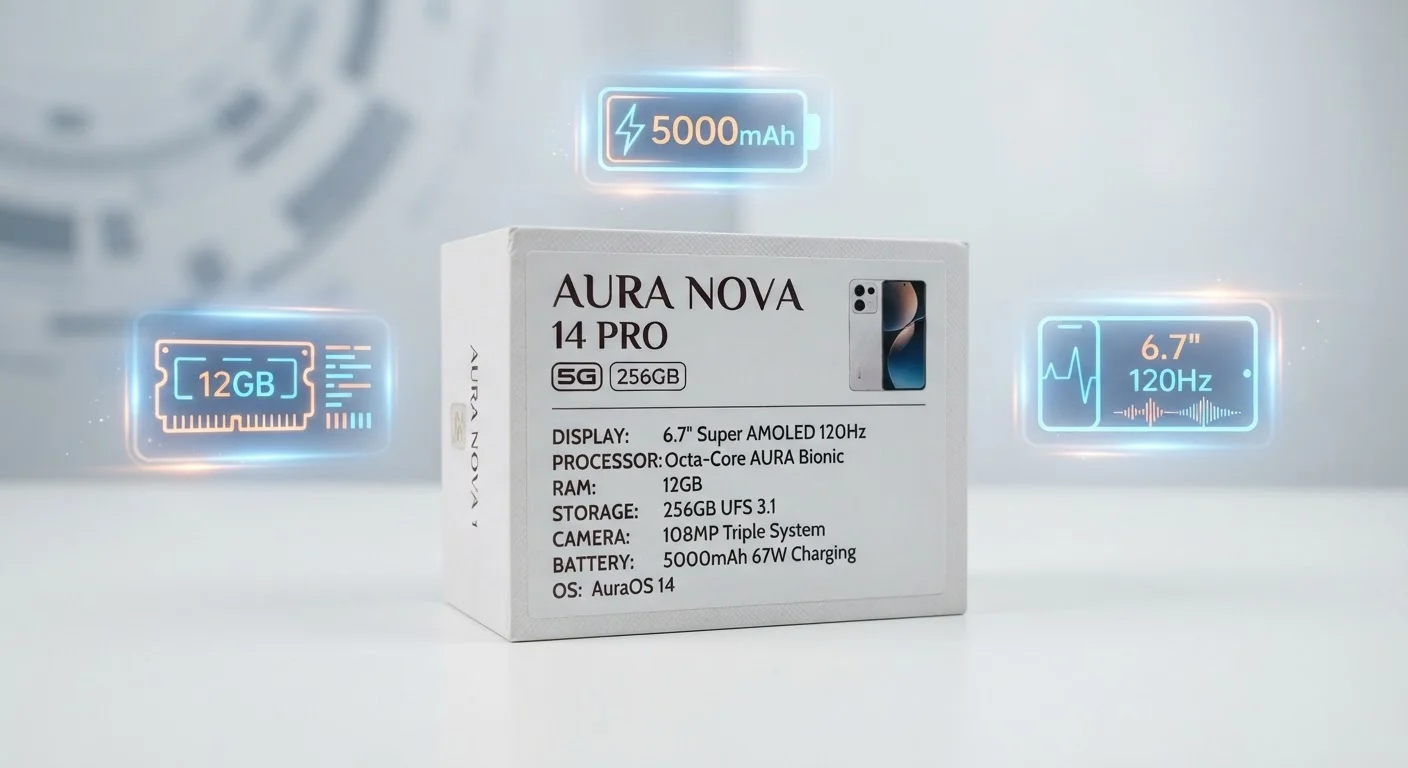
Why Specs Are Confusing - and How to Start Reading Them
Smartphone spec sheets pack a lot of numbers into a small space: gigabytes, gigahertz, nits, milliamp-hours. Without context, these figures mean very little. But each number corresponds to something concrete about how the phone will perform in your hand.
The key is knowing which specs tie directly to the tasks you care about - and which are mostly marketing shorthand. This reference guide walks through the most common specs category by category so you can decode any box or product page with confidence.
RAM
Random Access Memory - temporary storage that holds apps currently running on your phone. More RAM means more apps can stay open simultaneously without needing to reload.
mAh
Milliamp-hour - the unit used to measure battery capacity. A higher mAh number generally means longer battery life, though efficiency also depends heavily on the processor and software.
Nits
A unit of screen brightness. Higher nit counts make a display easier to read in direct sunlight; anything above 800 nits is generally considered good for outdoor use.
Refresh rate (Hz)
How many times per second the screen redraws its image. A 120Hz display feels noticeably smoother for scrolling and gaming compared to a standard 60Hz screen.
Internal storage (GB)
The permanent space where your photos, apps, and files live. Unlike RAM, storage is not erased when the phone powers off.
Chipset / SoC
System on a Chip - the central processor that handles nearly everything the phone does, from running apps to managing battery efficiency and camera processing.
RAM, Storage, and Processor: The Performance Core
RAM determines how many things your phone can juggle at once. If you frequently switch between apps - say, a navigation app, a music app, and a browser - more RAM means those apps stay loaded in the background instead of restarting. For most users, 6-8 GB is sufficient; heavy multitaskers or mobile gamers may benefit from 12 GB or more. For a side-by-side comparison with how the same spec works on laptops, see what RAM and storage mean on laptops.
Internal storage is where everything lives permanently. Photos, apps, downloaded podcasts - all of it sits in storage. Consider how you typically use your phone before choosing a capacity. A practical breakdown is available in our guide to how much storage you actually need.
The chipset - also called the processor or SoC - is the single most influential spec on the list. It governs app speed, camera processing, battery efficiency, and how well the phone handles demanding tasks. Our deeper guide explains what the processor chip inside your phone actually controls.
| Typical RAM range (modern phones) | 6 GB - 16 GB |
| Average smartphone battery capacity | 4,000 - 5,000 mAh |
| Standard display refresh rate | 60 Hz (budget) / 90-144 Hz (mid-to-flagship) |
| Common internal storage options | 128 GB, 256 GB, 512 GB |
| Outdoor-readable brightness threshold | 800+ nits |
Display Specs: Brightness, Refresh Rate, and Resolution
Display specs affect your experience every single time you look at the phone, so they deserve careful attention.
- Resolution (e.g., 1080p, 1440p) describes how many pixels fit on the screen. Higher resolution means sharper text and images, though the difference is less obvious on smaller screens.
- Refresh rate (Hz) controls smoothness. A 120 Hz display redraws the image 120 times per second, making scrolling and animations feel fluid. Most users notice the jump from 60 Hz to 90 or 120 Hz right away.
- Brightness (nits) determines how visible the screen is in sunlight. For anyone who regularly uses their phone outdoors, this spec matters more than resolution.
120 Hz
Refresh rate at which scrolling feels visibly smoother
Display manufacturers and independent reviewers widely cite 90-120 Hz as the threshold where most users notice a perceptible smoothness improvement over 60 Hz.
6 GB
Minimum RAM for smooth multitasking on Android
General guidance from Android developers suggests 6 GB RAM as a practical floor for keeping several apps open without constant reloading.
Display type also matters - OLED screens typically offer deeper blacks and richer colors than LCD panels, though either technology can be executed well or poorly depending on the manufacturer's calibration.
Battery, Charging, and Connectivity Numbers
Battery capacity in mAh is a rough guide to how long a charge will last. A 5,000 mAh battery holds more energy than a 3,500 mAh one, but real-world endurance also depends on the processor's efficiency, screen brightness settings, and usage patterns. Two phones with the same mAh rating can have meaningfully different all-day battery life.
Charging speed (watts) tells you how fast the battery refills. A 65W charger will bring a phone from empty to full considerably faster than a 15W charger. Check whether the required charger is included in the box - many manufacturers now ship phones without one.
On the connectivity side, 5G is now listed on most mid-range and flagship phones. Whether it genuinely benefits you depends on your carrier and location - our explainer on 5G on smartphones covers when it actually matters versus when it's mainly a marketing point.
Specs Tell Part of the Story
Two phones with identical numbers on the box can feel noticeably different to use. Software optimization, display calibration, and build quality all shape the day-to-day experience in ways that raw specs cannot capture. See why similar specs can feel different for a deeper look.
For camera-specific numbers - megapixels, aperture, sensor size - those specs follow their own logic. Our guide to phone camera specs that matter separates the meaningful figures from the noise.
The content on this site is for informational purposes only and is not a substitute for professional advice. Always consult a qualified professional for guidance specific to your situation.