

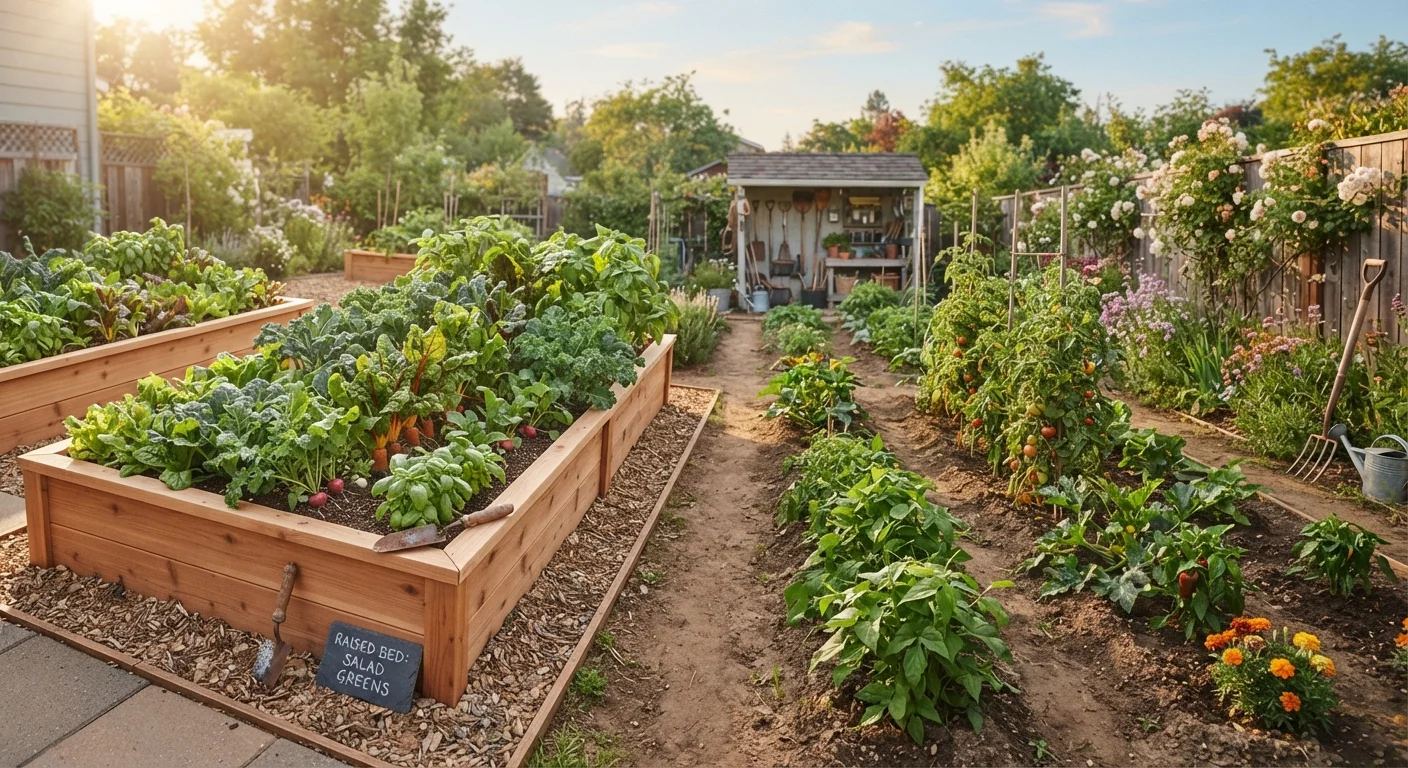
Option A
Raised Bed Gardening
The controlled, accessible growing environment.
Best for: Homeowners with poor native soil, limited mobility, or compact yards who want tight control over growing conditions.
Option B
In-Ground Gardening
The traditional, expansive approach.
Best for: Gardeners with naturally good soil, large planting areas, or plans for deep-rooted crops and perennial plantings.
The Core Differences at a Glance
Choosing between raised beds and in-ground gardening isn't about which method is universally better - it's about which fits your specific yard, soil, and physical situation. Both approaches can produce excellent results; they simply work differently and demand different investments of time and money up front.
Raised beds are contained growing areas - typically framed with wood, metal, or composite material - filled with imported or amended soil. In-ground gardens use the existing earth in your yard, improved as needed with compost or fertiliser. That single distinction drives most of the practical differences between the two methods.
| Criterion | Raised Beds | In-Ground Gardens |
|---|---|---|
| Startup cost | Moderate to high (materials + fill) | Low (tools + compost) |
| Soil control | Full - you choose what goes in | Dependent on native soil |
| Drainage | Excellent; may dry out faster | Varies by soil type |
| Scalability | Costly to expand | Easy and inexpensive to expand |
| Physical accessibility | High (less bending required) | Lower (ground level work) |
| Root depth available | Limited to bed depth (usually 8-18") | Unrestricted |
| Weed pressure | Reduced from ground; airborne seeds persist | Higher; requires consistent management |
| Long-term soil health | Requires periodic refreshing | Builds naturally over seasons |
If you're just getting started with food growing, our guide to starting a vegetable garden from scratch covers site selection and planning principles that apply to both approaches.
Soil Control and Drainage
Soil quality is where raised beds have the clearest advantage. When you build a raised bed, you choose exactly what goes into it - a custom mix of topsoil, compost, and other amendments - so you're not at the mercy of whatever the previous owners left behind. This matters enormously in neighborhoods where native soil is compacted, heavy with clay, sandy, or has a history of construction activity that stripped away topsoil.
Raised beds also drain more freely than in-ground plots, which helps prevent the root rot that plagues heavy soils. That same drainage, however, means the bed can dry out faster, so you may need to water more frequently - particularly in warm climates or during drought periods. Pairing raised beds with drip irrigation is a common and effective solution. Our comparison of drip irrigation vs. sprinkler systems can help you evaluate the right watering approach for whichever method you choose.
In-ground gardens rely on improving what's already there. With consistent additions of compost, in-ground soil can become rich and biologically active over years - but this is a longer-term project, not a quick fix. If your native soil is reasonably workable, the investment can pay off significantly over time.
6-8 weeks
Earlier planting possible with raised beds
Raised bed soil warms up faster in spring than ground-level plots, potentially extending the growing season in cooler US climates.
~60%
Of US home soil with poor structure
Extension horticulturalists commonly report that the majority of suburban lots have compacted or otherwise degraded topsoil due to construction activity.
Cost, Setup, and Scalability
Setup cost is one of the most significant practical differences. An in-ground garden requires relatively little to start - some compost, basic tools, and your labor. A raised bed requires materials for the frame and enough quality growing medium to fill it, which can add up quickly when filling beds that are 12 inches or deeper.
The trade-off is predictability. Because you're filling raised beds with known materials, early results are often more consistent. In-ground gardeners sometimes spend several seasons improving soil before yields meet expectations - though that investment compounds over time.
Scalability also differs. Expanding an in-ground plot is largely a matter of digging and amending more ground. Adding raised bed capacity means purchasing additional materials. For very large planting areas, in-ground gardening typically costs less per square foot.
Worth noting: raised beds offer some pest and weed management advantages. Gopher cloth lining the bottom of a raised bed deters tunneling animals. Weeds from surrounding ground are partly blocked by the bed frame, though airborne weed seeds still reach the growing medium.
What Grows Best in Each
Most annual vegetables - tomatoes, lettuce, beans, peppers, cucumbers - perform well in both settings. Where the choice starts to matter is with plants that have specific root depth or spread requirements.
Deep-rooted crops like parsnips, large carrots, and winter squash with sprawling vines often do better in-ground, where root space is unrestricted and vines can spread without spilling over a container edge. Similarly, perennial edibles - asparagus, rhubarb, artichokes - are typically better suited to in-ground planting where they'll occupy the same spot for years without disrupting a managed bed.
Raised beds, on the other hand, excel with shallow-rooted crops, salad greens, herbs, and compact varieties specifically bred for container or intensive growing. Their contained environment also makes succession planting - sowing new seeds as soon as one crop is harvested - easier to manage and track. To extend your visual interest alongside edible crops, mixing annuals and perennials is a strategy worth exploring regardless of the bed type you choose.
A Note on Contaminated Soil
If your property has a history of industrial use, older painted structures, or is near a heavily trafficked road, soil contamination (including lead) may be a real concern. Raised beds filled with imported soil offer a meaningful protective barrier in these situations. Before eating produce grown in ground you're uncertain about, consider having your soil tested through your local cooperative extension service - many offer low-cost testing for homeowners.
Accessibility, Maintenance, and Long-Term Planning
Physical comfort matters more than many gardeners expect when they're starting out. Raised beds at 18-24 inches tall allow gardeners with back or knee problems to tend plants without sustained bending. This isn't just a convenience - for many homeowners, it determines whether the garden stays active year after year or gradually gets abandoned.
Maintenance patterns also differ. Raised bed soil tends to stay loose and workable because it isn't walked on - a major reason for soil compaction in in-ground plots. In-ground gardens require defined pathways between rows and periodic aeration to prevent compaction. Both systems benefit from mulching to retain moisture and suppress weeds. Our practical guide to garden mulch types and uses covers the options suited to each approach.
Long-term, in-ground gardens build soil biology that improves steadily with organic matter additions - earthworms, beneficial microbes, and fungi all expand over seasons. Raised beds may need soil refreshed or topped up annually as organic matter breaks down. Neither is inherently more or less work; they simply require different maintenance rhythms.
The wisest approach for most homeowners is to start with one method in a limited area, observe how your yard and plants respond, and expand from there.
The content on this site is for informational purposes only and is not a substitute for professional advice. Always consult a qualified professional for guidance specific to your situation.