
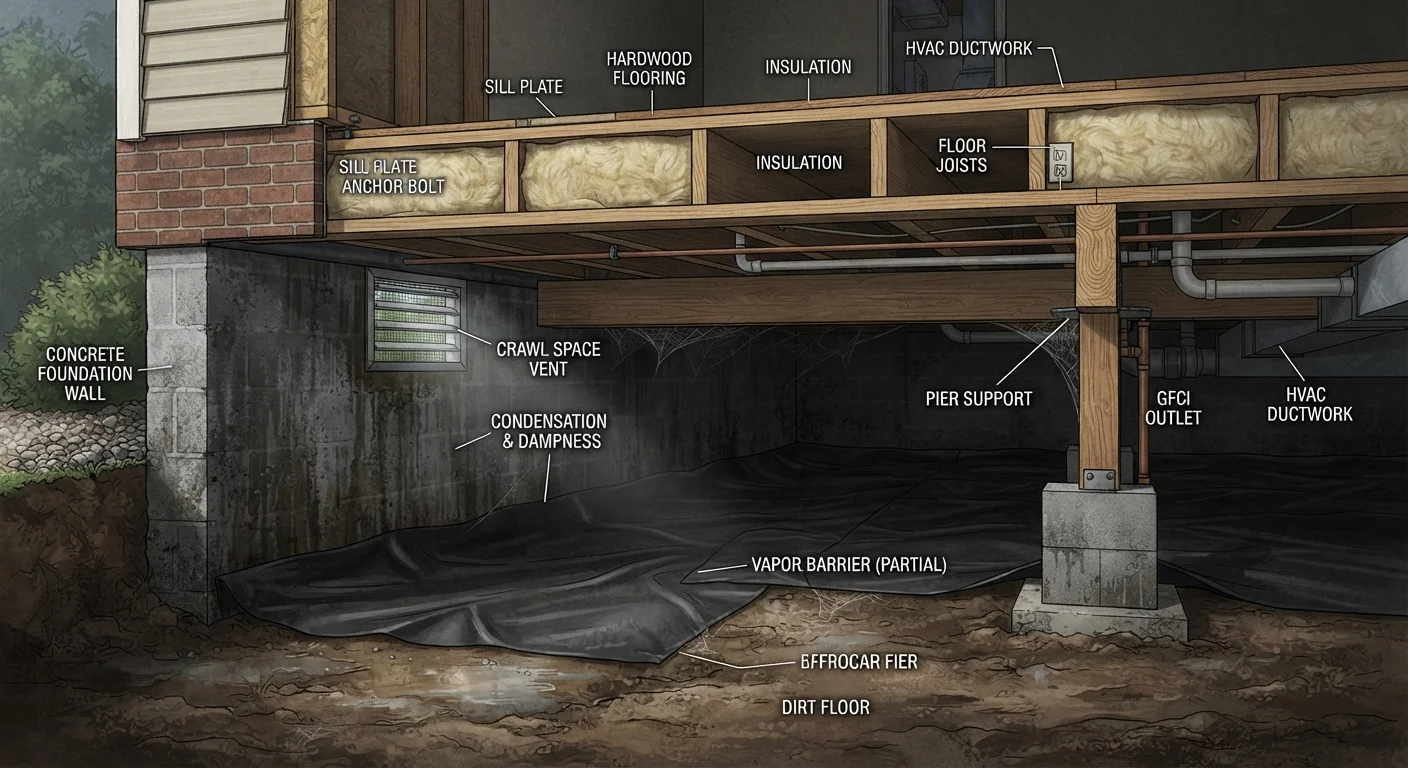
Where the Moisture Actually Comes From
Most homeowners assume a wet crawl space means a leaking pipe or a drainage failure - and while those can happen, they're not the most common culprit. The single largest source of crawl space moisture in most U.S. homes is the soil itself. Bare dirt floors release water vapor continuously through a process called evapotranspiration. That vapor has nowhere to go in a confined space, so it accumulates.
The second major source is outdoor air. Many older homes have foundation vents designed to allow cross-ventilation, based on the assumption that fresh air would carry moisture away. In dry climates that logic sometimes holds - but in humid regions, particularly during summer, those vents pull warm, humid air into a cool underground space. When warm air contacts cool surfaces like floor joists or ductwork, it reaches its dew point (the temperature at which vapor condenses into liquid water) and deposits moisture directly onto structural materials.
Grading problems around the home's foundation also contribute. If the soil outside slopes toward the house rather than away from it, rainwater channels toward the foundation and seeps through. Routine plumbing checks can also catch slow drips from supply lines or drain pipes running through the crawl space before they saturate the surrounding wood and soil.
Crawl Spaces Vary Significantly by Region
What works for a crawl space in Arizona may be exactly wrong for one in Florida. Dry-climate crawl spaces face different vapor dynamics than those in humid regions, which is why ventilation strategies, vapor barrier specifications, and encapsulation decisions should be evaluated for your specific climate zone. The U.S. Department of Energy's climate zone maps are a useful reference when researching appropriate standards for your area.
What Happens When Moisture Goes Unmanaged
Crawl space moisture damage tends to be slow and invisible - which is exactly what makes it costly. The most immediate concern is mold and mildew. Mold can begin colonizing wood within 24 to 48 hours of sustained dampness. Because the crawl space is below living areas, mold growth there often goes undetected until it has spread significantly or until occupants notice unexplained musty odors.
Over longer periods, sustained moisture causes wood rot in floor joists and the subfloor - the structural layer your floors rest on. Soft or bouncy flooring, doors that stick seasonally, and visible sagging are all late-stage signs of this kind of damage. Repairs at this point typically require licensed contractors and can be substantial.
Insulation doesn't escape unharmed either. Fiberglass batts hung between floor joists are particularly vulnerable - once they absorb moisture, they lose thermal resistance and can become a medium for mold. This connects directly to energy performance: a compromised crawl space can allow conditioned air to escape and cold air to infiltrate, a dynamic explored in more detail in our look at where home heat loss actually starts.
Use a Simple Humidity Gauge Year-Round
An inexpensive digital hygrometer (humidity gauge) placed in the crawl space gives you an ongoing picture of conditions without requiring a physical inspection every month. If you notice readings climbing above 60% RH over several consecutive readings, that's a cue to investigate ventilation, drainage, or vapor barrier gaps before moisture has time to do meaningful damage.
How Crawl Space Moisture Is Typically Managed
The most basic and widely recommended starting point is a vapor barrier - a polyethylene plastic sheet covering the soil floor. It doesn't eliminate all moisture, but it significantly reduces the amount of ground vapor entering the space. Building codes in many U.S. jurisdictions require a vapor barrier in new construction; for older homes without one, it's often the most cost-effective first step.
For persistently humid crawl spaces, particularly in the Southeast and Pacific Northwest, full encapsulation takes vapor barriers further by also sealing foundation walls and eliminating vents, effectively turning the crawl space into a semi-conditioned space. A mechanical dehumidifier rated for crawl space use is often added to actively control humidity levels. This approach requires professional assessment to ensure proper installation and code compliance.
Drainage corrections - regrading the soil around the foundation, extending downspouts, and installing French drains where groundwater intrusion is an issue - address moisture at its source. These solutions complement moisture control inside the crawl space rather than replace it. Homeowners dealing with water intrusion in adjacent below-grade spaces may also find useful context in understanding why basement waterproofing fixes fail and what addresses the root cause.
~60%
Relative humidity threshold for mold risk
Building scientists generally consider sustained relative humidity above 60% in a crawl space to be a condition favorable for mold growth and wood-destroying organisms.
18-24 hrs
Time for mold to begin colonizing wet wood
According to the U.S. EPA, mold can begin to grow on moist organic materials within 24 to 48 hours under favorable temperature conditions.
~15-25%
Of U.S. homes built on crawl space foundations
A significant share of American homes - particularly in the Southeast, Mid-Atlantic, and parts of the Northwest - use crawl space foundations, making this a widespread maintenance concern.
Building a Simple Inspection Routine
You don't need specialized equipment to keep tabs on your crawl space - a flashlight, a basic humidity gauge, and a willingness to get low twice a year will catch most problems early. During each inspection, look for standing water or dark staining on the soil, discoloration or fuzzy growth on wood surfaces, sagging insulation batts, and condensation on pipes or metal ductwork.
Check that any existing vapor barrier lies flat and covers the full floor without gaps. Look at foundation vents - if your home uses them - to confirm they open and close properly and that screens are intact to prevent pest entry. Small sealing oversights anywhere in the home's envelope can quietly worsen crawl space conditions, a point worth keeping in mind when reviewing common caulking and weather stripping mistakes.
If humidity readings consistently exceed 60% or you see evidence of mold or structural softness, that's the point to bring in a licensed professional - a structural engineer if you suspect joist damage, or a contractor specializing in crawl space systems for moisture control. Early intervention almost always costs less than late-stage remediation.
This article is for general informational purposes only. Home conditions vary widely; always consult a licensed contractor or building professional before undertaking significant crawl space work, and verify local permit requirements before making structural or encapsulation changes.
Frequently Asked Questions
Common signs include a musty odor coming through the floor, visible mold or efflorescence (white mineral deposits) on foundation walls, wood that feels soft or spongy underfoot, and condensation on pipes or ductwork. A simple humidity gauge placed in the crawl space can give you a concrete reading.
This depends on your climate and crawl space type. Traditional building codes assumed open vents would allow moisture to escape, but in humid climates, vented crawl spaces often make moisture problems worse by allowing warm, humid air inside. Many building scientists now favor sealed, conditioned crawl spaces - consult a licensed contractor familiar with your local conditions.
A vapor barrier is a sheet of polyethylene plastic laid over the soil floor to block ground moisture from evaporating into the space. Most crawl spaces benefit from one, especially those with exposed dirt floors. Thickness and coverage requirements can vary by local building codes.
Yes. Because air naturally moves upward through a home (a process called the stack effect), mold spores and musty odors from a damp crawl space can migrate into living areas. This is one reason that crawl space health is directly connected to the air your household breathes daily.
Basic vapor barrier installation is within reach for handy homeowners comfortable working in tight, low-clearance spaces. Full encapsulation - which seals walls, adds insulation, and often includes a dehumidifier - is more complex and typically benefits from professional assessment to ensure it meets local code requirements.
A general guideline is twice per year - once in spring after wet winter months and once in fall before winter. After any significant plumbing event, heavy rainfall, or flooding near the home, an immediate inspection is also sensible.
The content on this site is for informational purposes only and is not a substitute for professional advice. Always consult a qualified professional for guidance specific to your situation.