

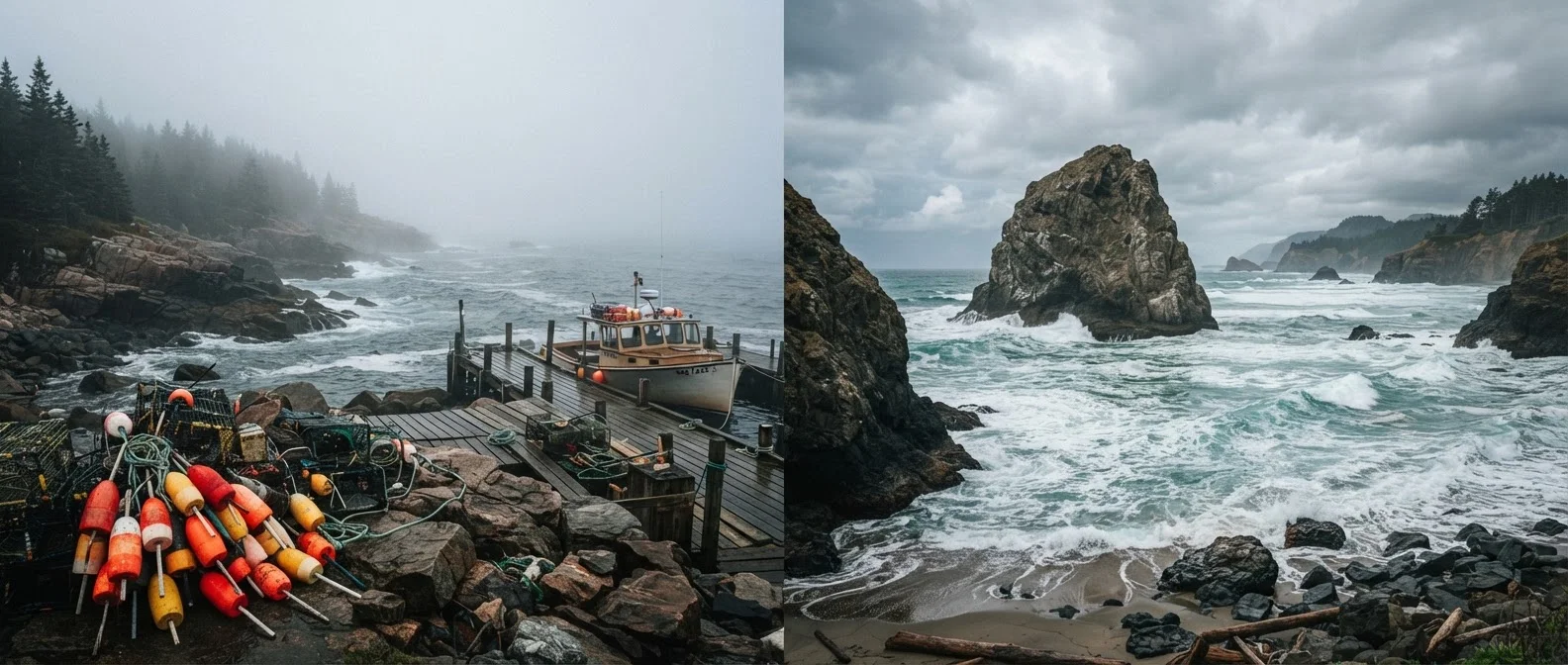
Option A
Coastal New England
The charming, history-rich Atlantic shore.
Best for: Travelers who want quaint harbor towns, fresh lobster, and centuries of American maritime heritage packed into a compact road trip.
Option B
Pacific Northwest Coast
The wild, moody edge of the continent.
Best for: Travelers who crave dramatic scenery, old-growth rainforests, whale-watching, and a slower, nature-first pace far from crowded resort strips.
The Landscapes: Postcard-Perfect vs. Primordially Wild
Coastal New England is a curated kind of beautiful. Think white-steepled villages perched above tidal marshes, lobster boats bobbing in granite-rimmed harbors, and lighthouses that look like they were built for a calendar shoot - because, essentially, they were. Maine's Acadia National Park anchors the northern end of this shoreline, offering mountain-meets-ocean views at Cadillac Mountain that feel almost impossibly scenic. Further south, Cape Cod's sandy dunes and Rhode Island's Gilded Age mansions add variety without breaking the postcard aesthetic.
The Pacific Northwest coast operates on a different emotional register entirely. Oregon's Highway 101 unspools past volcanic sea stacks, hidden coves carpeted in sea grass, and headlands where the wind genuinely pushes back. Washington's Olympic Peninsula hides the Hoh Rain Forest - one of the only temperate rainforests in the Northern Hemisphere - just minutes from the ocean. This is scenery that feels ancient and slightly untamed, a world away from New England's tidy charm.
| Criterion | Coastal New England | Pacific Northwest Coast |
|---|---|---|
| Scenery style | Charming harbors, lighthouses, sandy beaches | Sea stacks, rainforests, wild headlands |
| Summer weather | Warm, 70s°F, mostly sunny | Mild, 60s°F, partly cloudy |
| Crowd levels (peak) | Very busy July-August | Busy but less dense in summer |
| Food culture | Lobster, clam chowder, seafood shacks | Dungeness crab, smoked salmon, Pacific Rim |
| Getting around | Walkable towns, easy driving | Car essential, long drives between stops |
| Wildlife highlights | Whales, seabirds, seals | Gray whales, sea lions, bald eagles, elk |
| Cultural depth | Colonial history, maritime museums | Indigenous heritage, frontier history |
| Best for families | Yes - dense attractions, short distances | Yes - if comfortable with longer drives |
Weather, Seasons, and When to Go
New England summers (June through August) are reliably warm - think 70s°F along the coast - and attract the heaviest tourist traffic. Fall is arguably the region's secret weapon: foliage season transforms the coastal hills into riots of orange and crimson, crowds thin, and the air turns crisply perfect. Winters are cold and some attractions close, making off-season travel a harder sell here than elsewhere.
The Pacific Northwest is famously overcast and mild almost year-round. Summer - specifically July and August - is when the coast actually delivers reliable sunshine and temperatures in the 60s°F. Spring and fall bring dramatic storm-watching opportunities that draw a dedicated crowd of their own. The shoulder season advantage is especially pronounced here: September sees far fewer visitors than August with only marginally worse weather.
3,500 mi
Combined U.S. Atlantic coastline from Maine to Connecticut
The NOAA Office for Coastal Management tracks over 95,000 miles of total U.S. shoreline when accounting for bays, inlets, and islands.
363 mi
Length of Oregon's Pacific coastline
Oregon's entire coast is publicly accessible by law - one of the few states in the country with a complete public shoreline mandate.
~140 days
Average annual foggy or overcast days in coastal Oregon
NOAA climate data shows coastal Oregon averages notably more cloud cover than New England's summer corridor, shaping the region's moody aesthetic.
Culture, Food, and the Pace of Each Coast
New England's coastal culture is inseparable from the sea - but in a commercial, historical way. Lobster pounds, clam chowder, whale-watching out of Gloucester, and maritime museums fill the itinerary naturally. Towns like Newport, Rockport, and Bar Harbor have well-developed tourist infrastructure: reliable restaurants, inns with history, and clear signage. It's a coast that rewards wandering without much advance planning.
The Pacific Northwest coast moves more slowly and demands a bit more intention. Astoria, Oregon - the oldest American settlement west of the Rockies - punches above its weight culturally. Newport, Oregon offers a working fishing fleet and a world-class aquarium. The food culture leans heavily into Dungeness crab, smoked salmon, and farm-to-table Pacific Rim influences rather than the butter-and-chowder comfort of New England. For a broader sense of how dramatically American regions differ for travelers, the contrast here echoes the regional variety explored in Canada's regional travel differences.
Logistics: Getting There, Getting Around, and Costs
New England has a clear logistical edge for most Americans. Boston Logan is a major hub with competitive fares from most U.S. cities, and the region is drivable from the entire Northeast corridor. Once there, towns are close together - you can hit Portland, Maine; Kennebunkport; and Ogunquit in a single relaxed weekend. Accommodation spans all budgets, from basic motels to historic inns.
The Pacific Northwest requires more deliberate planning. Portland (PDX) and Seattle-Tacoma are the main gateway airports; rental cars are essentially mandatory since public transit doesn't serve the rural coast. Driving the full Oregon or Washington coastline is a multi-day commitment - which is a feature, not a bug, for road-trip enthusiasts. Prices along the coast tend to be lower than in New England's peak-demand summer window, but fuel costs for driving long stretches add up. Either way, neither coastline resembles the kind of overbuilt resort destination discussed in mountain vs. beach resort comparisons - both retain a genuinely regional character worth preserving.
Verify Entry and Conditions Before You Go
Park access, ferry schedules, and road conditions along both coastlines can change seasonally or due to weather events. Always check with the National Park Service, state tourism offices, and your transportation providers before finalizing travel plans. Neither region is immune to storm closures or seasonal service gaps.
The content on this site is for informational purposes only and is not a substitute for professional advice. Always consult a qualified professional for guidance specific to your situation.